Scientific Models as Constrained Simplifications
Scientific modeling is less a mirror of nature than a deliberate, constrained simplification of it.
The Geometry of Approximation
When engineers at Convair evaluated Space Shuttle designs in the late 1960s, they relied on stainless steel and aluminum miniatures. These physical models were not the shuttle itself, but a tangible distillation of aerodynamic variables—wings, tails, and fuselages—that could be tested in wind tunnels. The goal was never to replicate the spacecraft in its entirety, but to isolate the specific forces that would determine flight stability. This practice of reduction remains the bedrock of scientific inquiry, whether the subject is a vehicle or an invisible black hole.
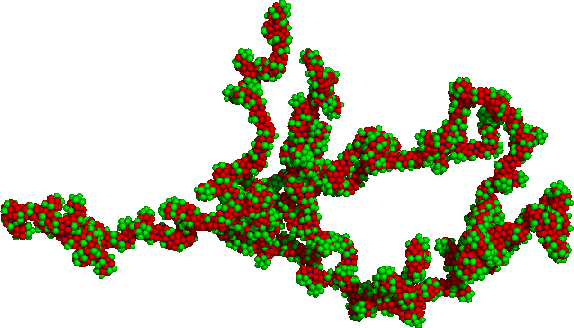
Modern computational approaches often mirror this physical heritage. In the study of active galactic nuclei, researchers now use Hamiltonian frameworks to infer coronal geometry from X-ray data. By treating the corona as a discrete grid subject to competing physical constraints like energy budget and magnetic coherence, they move away from rigid template-fitting. The resulting model is a geometry-agnostic representation that prioritizes physical consistency over a literal visual recreation, proving that the most useful models are those that define the limits of what they intend to measure.
A model is a set of priorities disguised as a description.
The Limits of the Equation
The tension between empirical data and theoretical elegance is nowhere more apparent than in the study of atomic and fluid dynamics. In chemistry, researchers have long sought to map the polarizability of ions, a fundamental property that dictates how electron clouds distort under electric fields. While quantum harmonic oscillator models provide a neat fit for atoms and cations, they falter when applied to the dispersed electron clouds of anions. The model fails not because the physics is wrong, but because the simplification—the assumption of a tidy, tight-binding structure—cannot accommodate the messy reality of the anion.
Similarly, oceanographers revisiting wave spectrum parameterizations have found that data collected half a century ago can lead to vastly different outcomes depending on the chosen mathematical tail. By comparing traditional frequency-dependent models against new spatial measurements, researchers have shown that selecting one parameterization over another can alter the equivalent roughness in boundary layer simulations. A model is a choice, and in the case of the ocean, that choice ripples through every subsequent calculation of atmospheric flux.
Chemical Chaos and Cosmic Seeds
In the study of the early universe, models serve as a bridge between the sparse data returned by the James Webb Space Telescope and the complex reality of galaxy formation. When astronomers attempt to explain the mass-metallicity relation, they must account for the stochastic flickering of star formation. If a model assumes too much volatility, it predicts a state of chemical chaos that contradicts observed galaxy distributions. The successful model is one that finds the right balance of feedback and delay, effectively filtering out the noise to reveal the underlying physical evolution.
This same tension defines the search for the origins of supermassive black holes. By testing astrophysical seeding mechanisms against primordial black hole theories, researchers can reproduce the observed masses of high-redshift systems like UHZ1 and GHZ9. These models do not prove a single origin story; rather, they demonstrate that specific parameters—accretion rates and supernova feedback—can generate the observed results. The model acts as a sieve, allowing scientists to narrow the range of possibilities for how the universe began.
A model that explains everything may explain nothing at all.
The Persistence of the Framework
Some models possess a longevity that transcends their original purpose. The two-process model of sleep regulation, introduced over four decades ago, continues to guide research into circadian rhythms and homeostatic pressure. It persists because it provides a robust conceptual architecture that can be updated as new data emerges, from synaptic-level investigations to proteomic analysis. It is a framework that survives by remaining flexible enough to incorporate new domains of inquiry without losing its core logic.
In contrast, the field of machine-learning weather prediction is currently grappling with the weight of its own inheritance. By adopting the initial-value-problem framing of traditional numerical weather prediction, modern models are often constrained by the very structures they seek to replace. The challenge for the next generation of models is to decide whether to remain embedded within physical systems or to embrace a data-driven approach that ignores traditional structural constraints. In every field, the model remains a negotiation between the known past and the uncertain future.