Inference Geometry: Modeling Complex Systems
From the electron clouds of ions to the birth of the first galaxies, scientific modeling is the art of choosing which complexities to ignore.
The Proxy for Reality
Scientific modeling is rarely a direct transcription of nature. Instead, it is an exercise in strategic simplification, where the goal is to capture the essential behavior of a system while pruning away the infinite complexity of the real world. In chemistry, this manifests as the quest for polarizability—a measure of how an electron cloud yields to an electric field. Because calculating these values from first principles is computationally expensive, researchers develop systematic models that correlate polarizability with simpler geometric properties like van der Waals radii. These models allow us to predict molecular interactions without solving the entire quantum mechanical puzzle for every atom.
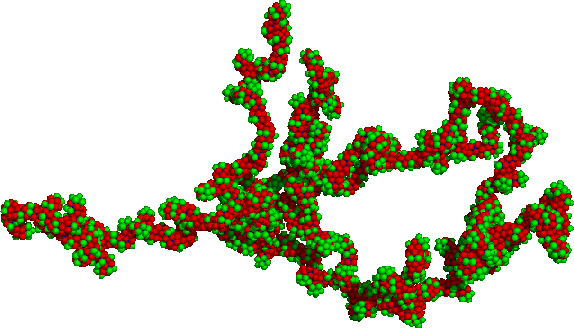
This same impulse governs the design of instruments. When researchers build a model for the STIX X-ray spectrometer on the Solar Orbiter, they do not attempt to simulate every atom in the device. They use Monte Carlo methods to represent the instrument's geometry and physical responses, validating the result against a known standard like the Crab Nebula. Whether it is the fractal adhesion models used to approximate the irregular shapes of interstellar dust or the force fields used to simulate ions, the model acts as a bridge between the messy, granular reality of matter and the clean, predictive language of mathematics.
A model is not a replica of the world, but a curated set of assumptions designed to make the world legible.
The Threshold of Chaos
In the study of galaxy evolution, models serve as the primary tool for interpreting the vast, light-years-spanning history of the universe. The mass-metallicity relation—the observed link between a galaxy's stellar mass and the chemical enrichment of its gas—is a fundamental diagnostic. Yet, when astronomers compare observations from the James Webb Space Telescope to high-resolution simulations, they find that the model's success depends on the inclusion of specific, often volatile, variables. If a model assumes too much stochasticity in star formation, it predicts a state of chemical chaos that contradicts the orderly trends we observe in the early universe.
These models must also account for the environment-dependent nature of stellar populations. By updating galaxy chemical evolution codes to include variable initial mass functions, researchers have found that our estimates for fundamental properties like star formation rates can shift by an order of magnitude. The model is not just a passive container for data; it is an active participant in defining what we believe to be true about the life cycles of galaxies. When the model and the observation diverge, it is often the underlying assumptions about feedback, accretion, or stellar birth that must be refined.
The Limits of the Known
When observations present us with phenomena that defy standard expectations, models become the only way to test alternative histories. The detection of massive black holes in the very early universe poses a significant challenge to conventional astrophysical seeding mechanisms. To reconcile these findings, researchers have turned to analytic models that explore primordial black holes as seeds. By adjusting parameters such as accretion rates and feedback, these models can replicate the observed mass ratios, effectively testing whether our current understanding of structure formation can accommodate these outliers.
Similarly, the mystery of quasi-periodic eruptions—recurrent X-ray flares from galactic nuclei—requires a model that can account for both the X-ray signatures and the delayed ultraviolet responses. By proposing a two-channel model involving a satellite black hole transiting an accretion disk, scientists can simulate the physical processes of gravitational focusing and magnetic reconnection. These models do not prove the existence of such a satellite, but they demonstrate that the observed data is not necessarily a sign of new physics, but perhaps a predictable consequence of complex, interacting systems.
The Stability of the Equation
At the most fundamental level, modeling is a search for stability. In the study of relativistic tearing instability, which governs magnetic reconnection in high-energy plasmas, the traditional constant-potential approximation often fails to capture the physics of the non-ideal region. By moving to an extrapolated-potential approximation, researchers can better predict the most unstable wavenumber, providing a more robust benchmark for understanding phenomena like gamma-ray bursts. The refinement of the model is not merely a technical adjustment; it is a correction of our physical intuition.
This pursuit of stability extends to the theoretical frontiers of dark energy. When analyzing models like freezing gravity, researchers must ensure that the inclusion of matter does not introduce ghost or gradient instabilities that would render the model physically impossible. By separating the background evolution from the perturbation dynamics, they create a framework that can be tested against large-scale structure and gravitational lensing. In every case, the model's utility is defined by its ability to remain coherent under the weight of the variables we choose to include.