Geometric Inference in Scientific Modeling
Scientific modeling serves as a bridge between the raw data of observation and the underlying physical laws that govern the universe.
The Elasticity of Atoms
At the smallest scales, the behavior of matter is defined by its response to external influence. Polarizability, a measure of how easily an electron cloud distorts under an electric field, is essential for accurate molecular simulations. Recent theoretical work has refined our understanding of this property by deriving a systematic set of polarizabilities for atoms and ions across the periodic table. By applying high-level quantum mechanics, researchers have moved beyond previous approximations, finding that the relationship between an ion's size and its polarizability depends heavily on the nature of its electron cloud. While cations and neutral atoms follow a predictable harmonic oscillator model, anions remain recalcitrant, their dispersed electron clouds defying simple geometric scaling.
Modeling is not a mirror of reality, but a selective translation of it.
Fractal Dust and Cosmic Clutter
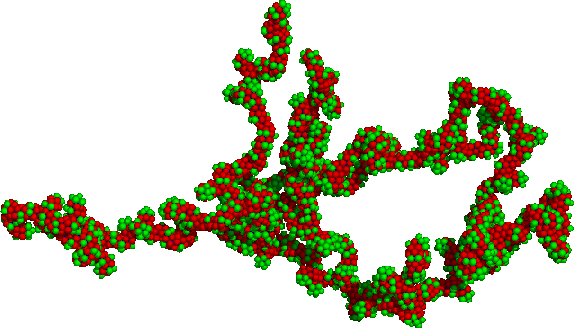
On a grander scale, the interstellar medium is filled with dust, yet the precise morphology of these grains remains elusive. Unlike the household lint we recognize, cosmic dust is a complex aggregate of carbon, silicon, and oxygen. Because we cannot hold a sample, we rely on fractal adhesion models to simulate how these grains might form through the random accumulation of spherical compounds. These models allow astronomers to predict how light is absorbed, emitted, and reflected, turning the visual evidence of dark nebulae into a quantifiable study of grain structure.
Calibrating the Invisible
Instrumental design requires its own form of modeling, where the physical hardware is recreated in the digital realm. The STIX instrument, designed to capture X-rays from solar flares, operates in an environment where every grid, window, and detector influences the incoming signal. By constructing a detailed Monte Carlo model based on Geant4, scientists can simulate the complex path of X-rays through the device. Validation against the steady emission of the Crab Nebula ensures that the model accurately accounts for internal scattering and fluorescence, providing the necessary response matrices to interpret the chaotic data of the sun.
The Evolution of Galaxies
When we look to the early universe, the James Webb Space Telescope provides a wealth of data that challenges our existing narratives. The observed mass-metallicity relation in galaxies—the balance between gas accretion, star formation, and supernova feedback—requires sophisticated hydrodynamic simulations to interpret. By developing minimal, physically motivated models, researchers have found that the dispersion in galaxy metallicity is highly sensitive to the stochastic nature of star formation. If star formation flickers too wildly, the chemical order we observe would dissolve into chaos, suggesting that galaxy evolution is a tightly regulated process rather than a random one.
The stability of the cosmos depends on the delicate regulation of its most violent processes.
Foundations of the Early Universe
The presence of massive black holes in the very early universe presents a significant puzzle for standard astrophysical models. To reconcile these observations, researchers have explored alternative seeding mechanisms, including the possibility of primordial black holes. By adjusting parameters for accretion and supernova feedback, these models demonstrate that early black holes could grow to exceed the mass of their host galaxies' stellar populations. Furthermore, by incorporating environment-dependent initial mass functions, scientists can refine their estimates of stellar mass and star formation rates, revealing that massive disk galaxies likely began their development much earlier than their smaller counterparts.