Spacetime Ripples Reveal Complex Origins
As our ability to detect the ripples of spacetime improves, the challenge shifts from finding the signals to understanding their complex, often messy, origins.
An Echo in the Void
When a mass accelerates, it ripples the fabric of spacetime, sending out gravitational waves. For decades, these signals remained theoretical, a subtle jiggle in the geometry of the universe that defied direct observation. The detection of these waves requires instruments of immense precision, such as the LIGO interferometers, which use laser beams to measure the infinitesimal stretching and squeezing of space itself. By comparing signals across separated detectors, researchers can filter out the terrestrial noise of a planet that never stops moving, isolating the faint signatures of distant, cataclysmic events.
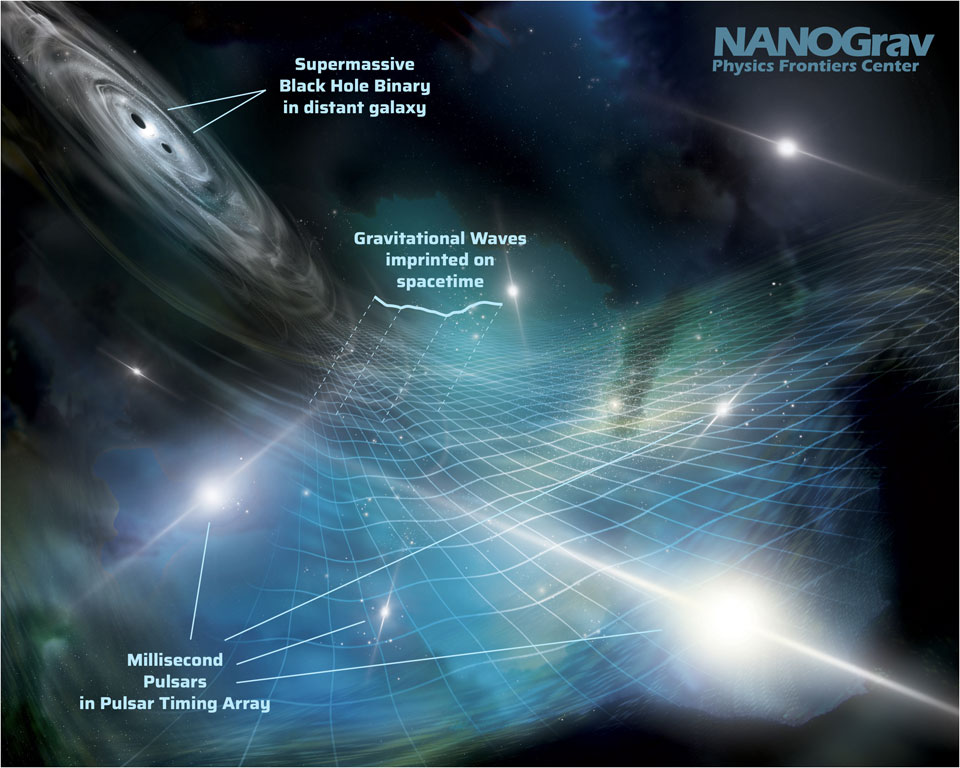
Beyond the high-frequency chirps of stellar-mass black holes, there exists a lower-frequency hum: a gravitational wave background. By monitoring the rhythmic pulses of dozens of distant pulsars, astronomers have detected correlated timing shifts across the sky. This suggests a vast, collective chorus of supermassive black hole binaries, each orbiting the other in a slow, inexorable dance. This background radiation provides a new vantage point, allowing us to map the gravitational landscape of the cosmos on scales far larger than individual mergers.
The universe does not merely exist; it vibrates, and we have finally learned how to listen to the hum.
The Limits of the Model
As our detectors grow more sensitive, the gap between our observations and our mathematical models becomes increasingly apparent. Current gravitational-wave astronomy relies on waveform models to infer the properties of merging black holes, such as their mass, spin, and distance. However, these models are not perfect. When a binary system involves high spin or significant mass asymmetry, the simplified waveforms used to interpret the data can introduce systematic biases. These errors are not merely academic; they threaten our ability to accurately measure fundamental cosmological constants, such as the Hubble-Lemaître parameter, which describes the expansion rate of the universe.
To address this, the next generation of observatories—such as the Cosmic Explorer and the Einstein Telescope—must be paired with more rigorous computational frameworks. These future facilities will be sensitive enough to detect events at much higher redshifts, potentially reaching back to the early universe. Yet, if our waveform models remain tethered to current approximations, we risk misinterpreting the very signals we have worked so hard to capture. Refinement of these models, through numerical relativity and more sophisticated analytical calculations, is the primary hurdle for the next decade of discovery.
The Complexity of the Dance
Not all binary systems follow the clean, circular paths that once defined our initial models. Many systems exhibit eccentricity, a deviation from the perfect circle that leaves a distinct imprint on the gravitational waveform. Detecting this eccentricity is vital for understanding how these binaries form in the first place, as different environments—such as dense stellar clusters—produce different orbital signatures. However, analyzing these eccentric signals is computationally expensive, requiring advanced techniques to manage the complexity of the parameter space.
Even more challenging are the extreme mass-ratio inspirals, where a compact object spirals into a massive black hole over millions of cycles. These systems are rich in information, encoding the strong-field gravity of the host black hole, but they also present significant modeling difficulties, particularly when orbital resonances occur. By employing new mathematical approaches, such as the Koopman operator, researchers are finding ways to track these resonances without the singularities that have plagued previous models. These tools allow us to extract the subtle physics of the inspiral, turning a chaotic signal into a coherent story of gravitational interaction.
Precision in the face of chaos requires us to master the mathematics of the orbit.
From Data to Discovery
The sheer volume of data expected from future detectors necessitates a shift in how we process signals. Machine learning is emerging as a critical partner, capable of generating surrogate waveforms that can speed up the analysis of complex events. While these models must be carefully calibrated to avoid introducing their own biases, they offer a path toward real-time parameter estimation for the hundreds of events we expect to see in the coming years. This speed is essential, as it allows for the rapid identification of events that might have electromagnetic counterparts.
One of the most promising applications of this data is the prediction of kilonovae—the explosive aftermath of neutron star mergers. By feeding gravitational-wave posterior samples into probabilistic frameworks, scientists can now forecast the light curves and spectra of these events before they are even fully observed by traditional telescopes. This integration of gravitational and electromagnetic data, known as multimessenger astronomy, transforms our understanding of the universe. We are no longer just listening to the ripples in spacetime; we are using them to predict the light that follows, linking the invisible physics of the merger to the visible fire of the explosion.