Ripples in the Fabric
As our sensitivity to the gravitational spectrum grows, the silence of the cosmos is being replaced by a complex, overlapping chorus of distant collisions.
The Expanding Horizon
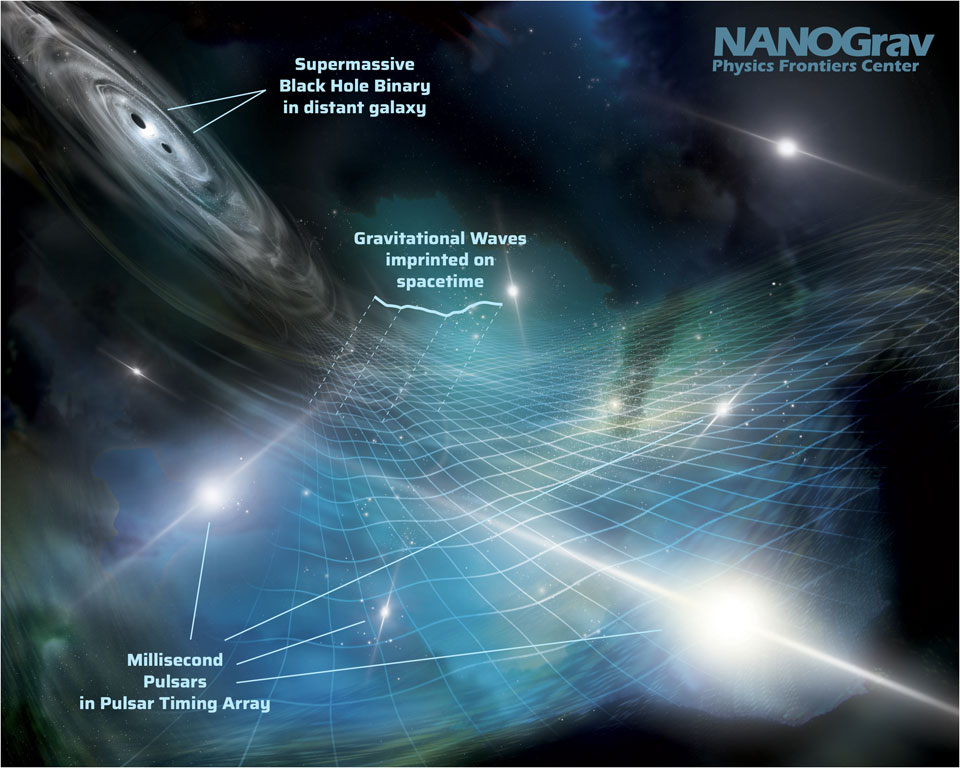
For decades, the study of gravity remained a largely theoretical pursuit, confined to the elegant equations of general relativity. That changed when terrestrial observatories began to register the faint, rhythmic tremors of spacetime caused by the collision of stellar-mass black holes. These initial detections, while historic, represented only a narrow slice of the gravitational spectrum. We are now moving toward a more comprehensive census of the universe, one that includes the low-frequency humming of supermassive black hole binaries and the high-frequency chirps of neutron star mergers. This expansion of our observational reach is not merely a matter of building larger machines; it requires a fundamental shift in how we interpret the subtle distortions in the data we collect.
The Problem of Precision
The current generation of detectors, such as LIGO and Virgo, has provided a robust confirmation of Einstein’s predictions, finding no evidence for physics beyond general relativity in the signals analyzed to date. Yet, as we refine our tools, the challenges of data analysis grow in complexity. When we look at binary systems, we are often searching for signatures of eccentricity or spin that can reveal how these objects formed and evolved. Distinguishing these physical characteristics from detector noise is a task of immense computational difficulty. Even as we employ advanced waveform models to account for higher-order modes, we find that certain effects—such as spin inversions in binary inspirals—can remain stubbornly hidden, masked by degeneracies that our current models struggle to resolve.
The imprint these waves make on spacetime itself is a distorted grid that we are only just beginning to read.
Computational Frontiers
To handle the deluge of data expected from future observatories like the Einstein Telescope or the space-based LISA, researchers are turning to machine learning and novel mathematical frameworks. Generating theoretical waveforms for every possible scenario is computationally prohibitive, leading to the development of surrogate models that can approximate these signals with high speed and accuracy. Similarly, addressing the physics of extreme mass-ratio inspirals requires new ways to handle orbital resonances, where standard mathematical approaches often break down. By promoting the waveform to an observable within the Koopman operator, scientists can now track these complex interactions without the singularities that once plagued our models.
A Unified View
The ultimate goal of this work is to bridge the gap between gravitational observations and the broader electromagnetic spectrum. By predicting kilonova spectra directly from gravitational wave data, we can create a probabilistic link between a silent merger and the visible light it produces. This multimessenger approach is essential for understanding the nuclear equation of state and the life cycles of the most massive objects in the cosmos. As we integrate these disparate data streams, we move closer to a unified view of the universe, where the gravitational background—the collective, overlapping signals of millions of distant events—becomes a tool for mapping the history of cosmic structure itself.
We are moving toward a more comprehensive census of the universe, one that includes the low-frequency humming of supermassive black hole binaries.