Shadows Across the Stellar Disk
As our detection methods sharpen, the galaxy reveals itself not as a collection of solar system replicas, but as a diverse and often extreme landscape of worlds.
The Search for a Mirror
For generations, the solar system was the only template for planetary existence. We assumed that the architecture of our own neighborhood—a orderly arrangement of rocky inner worlds and gas giants—was the standard. The early years of exoplanet research were defined by the search for this familiar configuration, a quest to prove that we were not a cosmic anomaly. When astronomers identified a Jupiter-like planet orbiting the star 55 Cancri in the early 2000s, it felt like a vindication of that hope. It suggested that the mechanics of our own system might be echoed across the galaxy.
We are no longer looking for the exception, but mapping the rule.
Measuring the Wobble
The methodology of discovery has shifted from the subtle to the statistical. Early detection relied on the radial-velocity method, which interprets the minute gravitational tugs a planet exerts on its parent star. By measuring the resulting wobble in the star’s motion, researchers could infer the presence of invisible companions. This approach remains essential, particularly for identifying massive, distant worlds like GJ 414 A c, which circles its orange dwarf star in a slow, frigid orbit of nearly 750 days.
The Transit Census
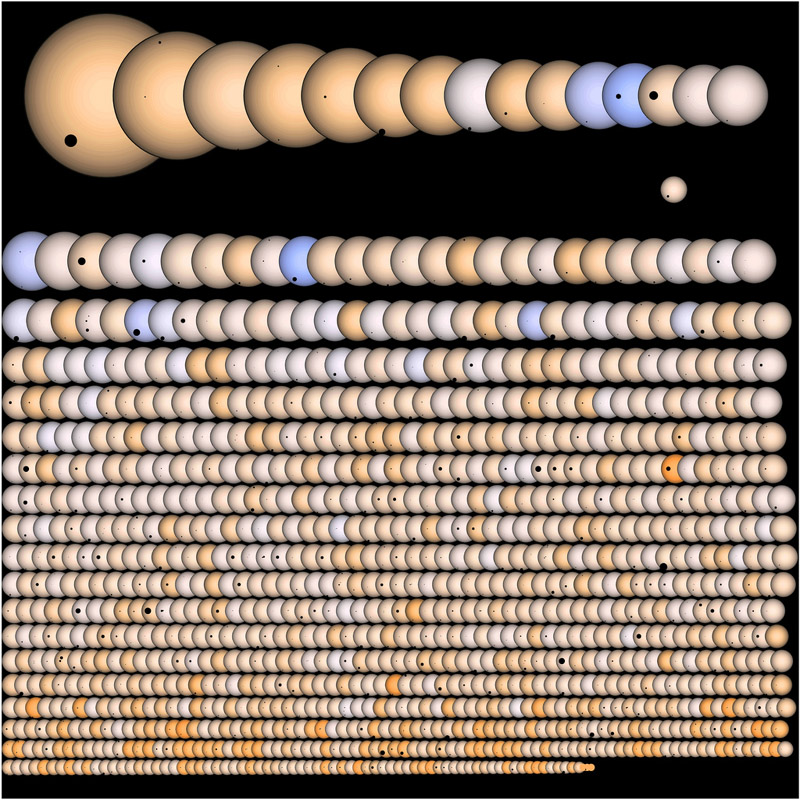
The landscape of discovery expanded dramatically with the transit method, which observes the periodic dimming of a star as a planet passes in front of it. This technique turned the Kepler mission into a prolific census-taker, identifying over a thousand candidates in a single sweep. By treating the star as a backlit screen, astronomers can silhouette the passing world, allowing them to calculate size and orbital frequency with remarkable precision. It is a game of patience, requiring a steady gaze at a fixed patch of sky to catch the fleeting shadow of a distant sphere.
Space is not a void, but a crowded gallery of silhouettes.
The Extremes of Proximity
The data returned by modern surveys like TESS reveals a galaxy far more diverse and often more extreme than our own. We now encounter worlds like GJ 806 b, a planet only slightly larger than Earth that completes an entire year in less than a single day. With an equilibrium temperature exceeding 600 degrees Celsius, it is a world defined by its proximity to a red dwarf, a far cry from the temperate stability of our own home. Similarly, HD 260655 b offers a glimpse into the frenetic pace of these systems, where orbits are measured in hours rather than months.
Beyond the Familiar
What emerges from these catalogs is not a collection of Earth-clones, but a vibrant, chaotic variety of planetary configurations. We have moved past the need to find a mirror of our own system to understand the nature of the cosmos. Instead, we are documenting a vast array of possibilities, from the massive, cold giants of the outer reaches to the scorched, rapid-fire worlds that hug their stars. Each new entry in the archive serves as a reminder that while our system may be stable, it is merely one variation in a much larger, more inventive design.