Neighbors in the Dark
The census of nearby star systems reveals a chaotic variety of worlds that defy our solar-centric expectations.
The View from the Porch
For generations, the night sky appeared as a static tapestry of distant points. We now know that this tapestry is teeming with activity. Within a stone's throw of our own solar system—cosmically speaking—lie dozens of worlds that challenge the tidy arrangement of the eight planets we call home. These exoplanets are not merely theoretical constructs; they are physical realities, detected through the subtle gravitational tugs they exert on their host stars or the fleeting shadows they cast as they cross their stars' faces.
We are finding that the neighborhood is far more crowded and far more varied than we once dared to imagine.
Gravity and the Wobble
Detecting these worlds requires immense patience and precision. The radial-velocity method, for instance, relies on the fact that a planet does not simply orbit a star; both bodies dance around a common center of mass. This causes the star to wobble, a rhythmic shift that astronomers can measure by tracking minute changes in the star's light. In the case of the GJ 414 A system, researchers identified two distinct companions by observing this telltale motion. One, GJ 414 A b, completes a circuit in roughly 50 days, while its sibling, GJ 414 A c, takes more than two years to finish a single lap.
The Transit Technique
While gravity reveals the mass of a world, the transit method offers a glimpse of its silhouette. When a planet passes directly between its star and our line of sight, the star's brightness dips, providing a clear signal of the planet's presence and size. This is how we identified HD 260655 b and GJ 806 b. These worlds are often found in tight, frantic orbits, racing around their red dwarf hosts in a matter of hours or a few days. Such proximity ensures these planets are scorched, with equilibrium temperatures reaching hundreds of degrees Celsius.
A planet that completes its year in less than a day is a world of extreme, unyielding heat.
Proxima and the Search for Home
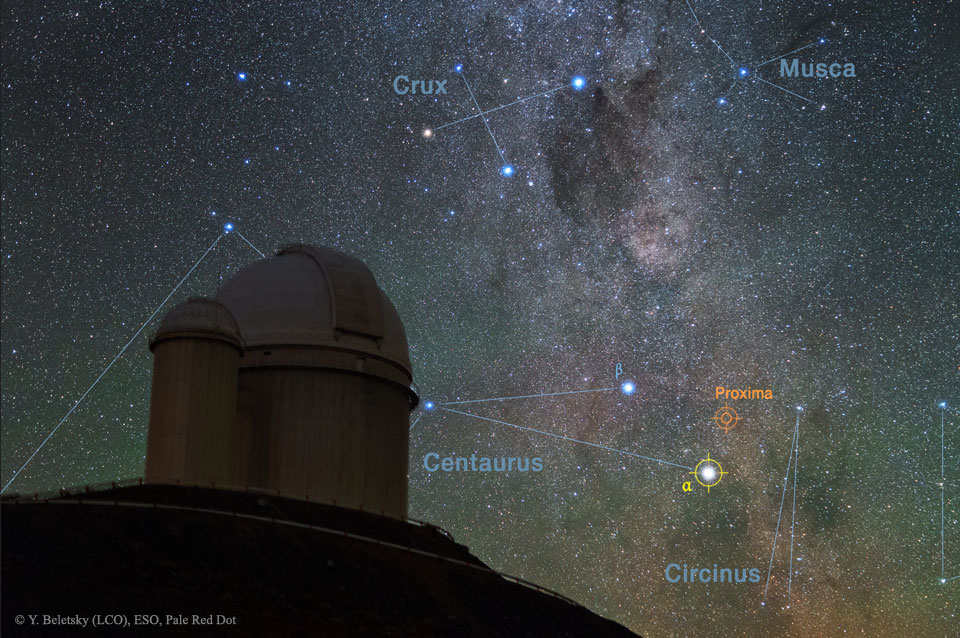
The most compelling target remains Proxima b, which orbits the star closest to our own Sun. Its existence, confirmed by the Pale Red Dot collaboration, suggests that even the most modest stars can host planets in the habitable zone. While we have yet to determine if Proxima b possesses an atmosphere or liquid water, its proximity—a mere 4.25 light-years away—makes it the primary candidate for future observation. It serves as a reminder that the conditions for life may be more common than the vast, empty spaces between stars would suggest.
A New Taxonomy
The data from these nearby systems forces a revision of our planetary categories. We see worlds with masses several times that of Earth, orbiting stars that are cooler and redder than our Sun. These systems, such as the two-planet arrangement around GJ 414 A, show that planetary architecture is rarely uniform. Whether through the slow, heavy pull of gravity or the quick, rhythmic blink of a transit, we are slowly mapping the immediate vicinity of our corner of the galaxy, finding that the universe is not just vast, but remarkably populated.