Cosmic Physics and the Limits of Matter
From the stable foundations of the standard cosmological model to the violent, high-energy physics of neutron stars and black holes, our understanding of the universe is being refined by a focus on the granular details of environment and interaction.
The Persistence of the Standard Model
Modern astrophysics is less a search for exotic anomalies than a rigorous audit of the mundane. By refining our understanding of the standard cosmological model, researchers are finding that the universe remains stubbornly consistent with established predictions. Recent measurements of the cosmic microwave background, for instance, show no significant departure from the baseline model, effectively narrowing the window for new, light, relativistic species or self-interacting dark radiation. The universe appears to be playing by the rules we have already written.
Environments and Their Influence
While the broad strokes of cosmology hold firm, the details of stellar evolution and galactic dynamics reveal a more complex, granular reality. In the study of Type Ia supernovae, which serve as essential distance indicators, researchers have discovered that environmental factors exert a far greater influence on luminosity than previously assumed. The way these stars behave is tied to the mass and color of their host galaxies, a finding that complicates the standardisation procedures used to map the expansion of the universe. We are learning that the tools we use to measure the cosmos are themselves subject to the subtle biases of their local surroundings.
This sensitivity to environment extends to the very birth of planetary systems. Observations of protoplanetary disks show that the distribution of ice and gas is not uniform but shaped by the specific geometry and thermal history of the system. Whether it is the high-altitude ice reservoirs in edge-on disks or the water vapor discs that might seed terrestrial planets with oceans, the chemical inventory of a young system is a product of its unique architecture.
The tools we use to measure the cosmos are themselves subject to the subtle biases of their local surroundings.
The Limits of Matter
The most extreme objects in the galaxy continue to challenge our grasp of fundamental physics. Neutron stars, with their city-sized radii and immense densities, act as natural laboratories for states of matter impossible to replicate on Earth. The discovery of massive pulsars like PSR J1614–2230 has forced a re-evaluation of the equations of state that govern these remnants, effectively ruling out models that rely on exotic matter like hyperons. When a star collapses, it leaves behind a structure that dictates the limits of what matter can endure.
Magnetars, too, push the boundaries of the possible. With magnetic fields a billion times stronger than those achievable in terrestrial laboratories, these objects demonstrate the violent potential of stellar death. Whether through the buckling of a neutron star's crust or the accretion flares of a central black hole, the high-energy universe is a place of constant, often chaotic, adjustment.
When a star collapses, it leaves behind a structure that dictates the limits of what matter can endure.
Invisible Forces and Large-Scale Dynamics
Beyond the individual star, the interplay between plasma and magnetic fields governs the transport of energy across vast distances. In ultra-high-beta plasmas, where magnetic pressure is dwarfed by thermal energy, the standard mechanisms of heat transport break down. Kinetic simulations suggest that heat is not merely diffused but advected by whistler waves, a process that changes how we model the reionised intergalactic medium. These microscopic instabilities have macroscopic consequences for the evolution of the universe.
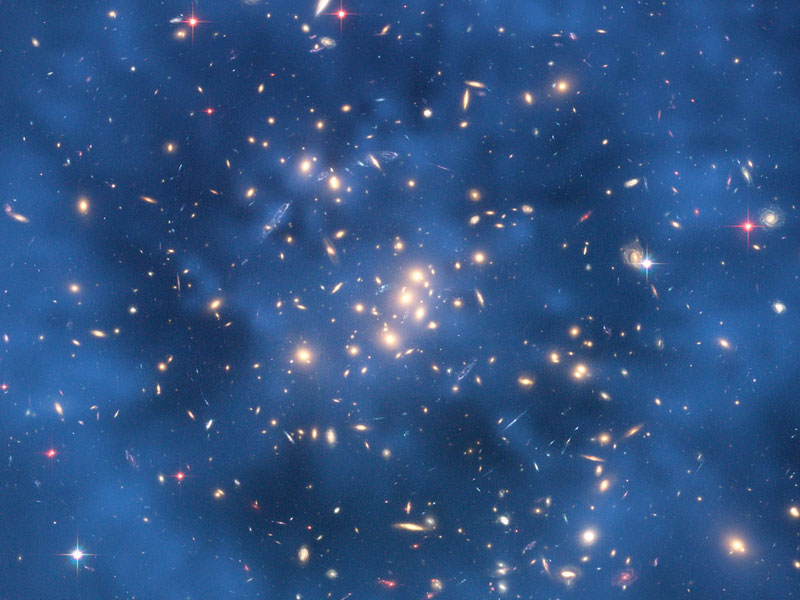
Even the largest structures, such as galaxy clusters, bear the marks of these hidden dynamics. The detection of dark matter rings, likely formed by the collision of massive clusters, provides a visual confirmation of gravity acting on invisible mass. These features, transient in the cosmic timeline, serve as a reminder that the universe is not a static stage but a dynamic system, constantly reshaped by the unseen forces of dark matter, magnetic fields, and the remnants of ancient collisions.
The Chemical and Temporal Record
The synthesis of heavy elements, or the r-process, remains a central mystery of nucleosynthesis. By applying Bayesian frameworks to the abundance patterns of metal-poor stars, researchers are beginning to map the conditions—entropy, electron fraction, and expansion timescales—required to forge the heaviest elements. This work connects the smallest nuclear interactions to the observed chemical composition of the galaxy, showing that even the most distant stars carry the signature of their explosive origins.
As we refine our observations, from the jets of young protostars to the changing-look active galactic nuclei that flare and fade over years, we are moving toward a more integrated view of cosmic history. The universe is not a collection of isolated events but a series of interconnected processes, where the life of a star, the growth of a black hole, and the distribution of elements are all part of a single, unfolding narrative.