Cosmic Expansion Metrics and Modern Observations
Recent advances in observational data and statistical modeling are forcing a re-evaluation of how we measure the evolution of the cosmos.
Beyond the Standard Model
Modern astrophysics has moved beyond the era of static models, shifting toward a rigorous interrogation of the forces that govern cosmic expansion. Recent studies, such as those employing the Weighted Function Regression method, have begun to move past the rigid constraints of the Chevallier-Polarski-Linder parametrization. By allowing data to dictate the evolution of dark energy without the bias of arbitrary truncation, researchers have identified a transition in dark energy behavior at a redshift of approximately 0.4. This suggests a shift from phantom to quintessence-like behavior, challenging the assumption of a monotonic expansion history.
The universe is not a static stage, but a restless, evolving mechanism that defies simple categorization.
Testing the Limits of Relativity
The search for precision extends to the fundamental laws of gravity themselves. By analyzing clustering measurements from the Dark Energy Spectroscopic Instrument, researchers have tested for deviations from general relativity. These efforts, which combine cosmic microwave background data with supernova observations, consistently align with the predictions of general relativity. Whether examining the non-minimal coupling of dark energy or the subtle parameters governing gravitational growth, the data currently favor the established framework, effectively narrowing the window for alternative theories.
Standardizing the Transient
To probe the deep past, astronomers rely on standardizable candles that reach across vast temporal distances. Gamma-ray bursts, once considered too erratic for precise measurement, are being recalibrated through model-independent approaches. By utilizing cosmic chronometers and Bayesian reconstruction, researchers are identifying sub-samples of these energetic transients that adhere to the Dainotti correlation. This allows for a more reliable extension of the cosmic distance ladder, providing a clearer view of the universe at redshifts far beyond the reach of traditional supernovae.
The Feedback Loop
On a more local scale, the life cycles of stars and the feedback they provide to their environments remain a primary focus. Observations of the supermassive star cluster Westerlund 1 reveal a complex, shocked plasma environment, where stellar winds and turbulent mixing create diffuse X-ray emission. Similarly, high-resolution imaging of Betelgeuse shows persistent, asymmetric structures in its inner atmosphere, likely driven by stable convective cells. These findings underscore the role of stellar feedback in shaping the interstellar medium, a process that begins in the dense, cold gas of infrared dark clouds long before the first light of a new cluster emerges.
Instruments of Discovery
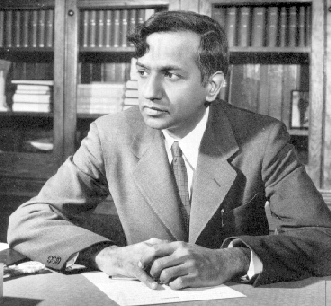
The tools of observation have evolved from the foundational work of figures like Subrahmanyan Chandrasekhar to the unprecedented sensitivity of the James Webb Space Telescope. The MIRI Deep Imaging Survey of the Hubble Ultra Deep Field provides a view of the universe at wavelengths previously inaccessible, revealing mature stellar populations in galaxies at high redshifts. Meanwhile, the DIRECD catalog demonstrates how coronal dimmings can be used to map the three-dimensional trajectory of mass ejections from the Sun. These advancements, paired with sophisticated simulations of dark matter filaments, continue to refine our understanding of a universe that is as dynamic in its smallest local interactions as it is in its largest cosmic structures.