Signals from the Deep Field
From the magnetic heating of the solar corona to the gravitational echoes of early galaxy formation, modern astrophysics is refining its view of a dynamic and interconnected cosmos.
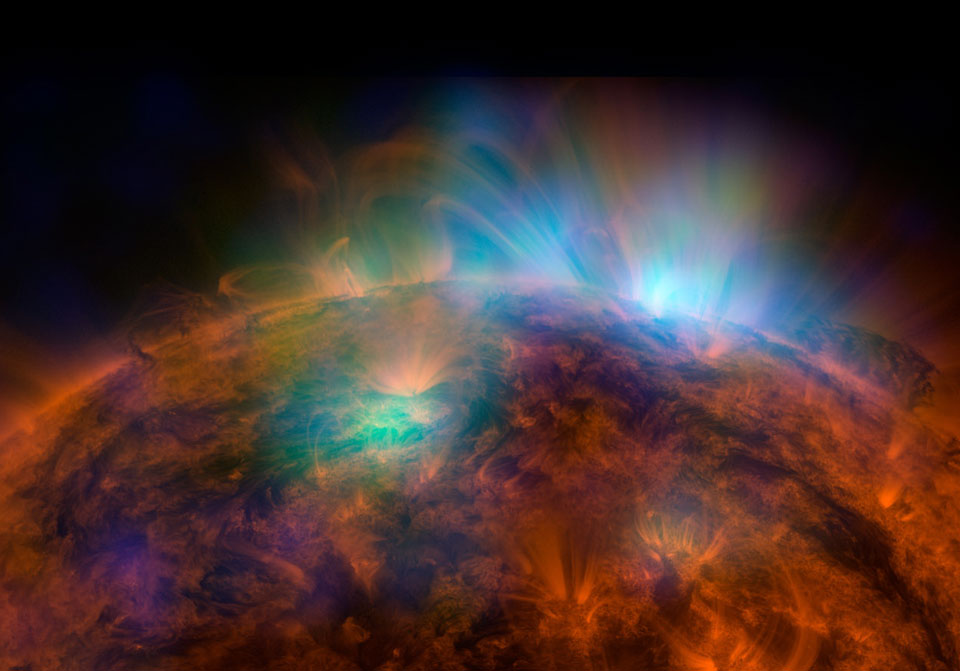
The Persistent Mystery of Solar Heat
The solar atmosphere presents a paradox that has long occupied solar physicists like Louise Harra. While the photosphere—the visible surface of the Sun—maintains a temperature that allows for the existence of sunspots, the regions extending far above them into the corona reach temperatures hundreds of times higher. This inversion of expected thermal gradients suggests that energy is being deposited into the outer layers through mechanisms that remain elusive. Observations from instruments like the Nuclear Spectroscopic Telescope Array (NuSTAR) have begun to map these high-energy X-ray emissions, providing a clearer look at the localized heating occurring above active regions.
The sun’s outer atmosphere defies the simple logic of distance, burning millions of degrees hotter than the surface that anchors it.
Tracing the Magnetic Topology
Recent efforts to resolve this heating have turned to the fine structure of the solar atmosphere, such as the spongy, high-temperature features known as solar moss. By combining high-resolution spectropolarimetric data with multi-height magnetic field extrapolations, researchers have begun to trace the complex connections between photospheric magnetic fields and the chromospheric loops above. Evidence suggests that energy release may be driven by magnetic reconnection, where twisted field lines snap and reconfigure, dumping thermal energy into the plasma and driving flows along the resulting magnetic structures.
Galactic Ripples and Satellite Perturbations
Beyond our immediate stellar neighborhood, the Milky Way itself exhibits signs of a turbulent history. Data from the Gaia mission have revealed vertical oscillations within the Galactic disc, manifesting as phase spirals in the distribution of stars. Simulations suggest these ripples are not internal accidents but the result of external interference. The Sagittarius dwarf galaxy, in its passage through the Milky Way, appears to have excited a bending mode that eventually transitioned into a breathing mode, sustained by the subsequent formation of spiral arms. This transition provides a timeline for the interaction, placing a significant gravitational disturbance within the last half-billion years.
The Milky Way is not a static disc, but a vibrating system echoing the gravitational tugs of its satellites.
Early Galaxies and Chemical Chaos
In the early Universe, the assembly of galaxies was governed by a delicate balance between gas accretion and the feedback loops of star formation. Observations from the James Webb Space Telescope have revealed that the mass-metallicity relation—a fundamental metric for galaxy evolution—was already established as early as redshift z ∼ 17. However, the dispersion in these measurements is highly sensitive to the stochastic nature of star formation. If star formation were too erratic, it would lead to a state of chemical chaos that would erase the clear trends observed in current spectroscopic data, suggesting that feedback processes are more regulated than some extreme models initially proposed.
Refining the Search for Gravitational Waves
The study of massive, star-forming galaxies at high redshift shows that many share a common disc-like structure, even if their gas discs are prone to instability. As we look toward future gravitational-wave observatories like LISA, the ability to distinguish between different binary configurations becomes critical. Current research into spin-inversion degeneracies suggests that some complex spin motions in supermassive black hole binaries may be difficult to disentangle from simpler, non-crossing waveforms using current models. Simultaneously, the development of machine-learning surrogate waveforms is helping to bridge the computational gap, allowing for faster parameter estimation despite the inherent biases that must be corrected to maintain accuracy.
As we expand our catalog of binary systems, the challenge shifts from detection to the precise interpretation of complex, overlapping signals.