Echoes of the Invisible
Modern astrophysics is less a matter of peering through a telescope than of interpreting the subtle, rhythmic tremors of the universe.
The Rhythms of the Disc
The Milky Way is not a serene, fixed spiral, but a dynamic system defined by constant vertical motion. Recent high-resolution simulations suggest that our galaxy’s disc is currently vibrating, caught in a complex interplay between the direct gravitational pull of the Sagittarius dwarf galaxy and the indirect ripples created by spiral arms. These oscillations manifest in two distinct forms: a bending mode, which acts like a global wave, and a breathing mode, which causes the disc to expand and contract. Over time, the bending mode fades, leaving behind a persistent breathing pattern that leaves a signature in the phase-space of local stars.
This structural restlessness is not unique to our own galaxy. Surveys of edge-on, Milky Way-mass galaxies reveal that kinematic sub-structures—such as boxy-peanut bulges and nuclear discs—are common features rather than anomalies. By analyzing the velocity and dispersion of stars in these distant systems, researchers can map the internal history of galactic evolution. These observations confirm that the internal life of a galaxy is a result of ongoing, subtle interactions that continuously reshape its physical profile.
Galaxies are not static monuments but fluid systems, constantly rearranging their internal architecture in response to external tugs.
Chemical Chaos and Cosmic Feedback
The evolution of a galaxy is fundamentally a struggle between the accumulation of gas and the violent expulsion of material through stellar feedback. By studying the mass-metallicity relation—the correlation between a galaxy's stellar mass and the chemical composition of its gas—astrophysicists are beginning to understand how star formation is regulated across cosmic time. High-resolution data from the James Webb Space Telescope indicates that this relationship is highly sensitive to the stochastic nature of star formation, often described as flickering.
If star formation were too erratic, the resulting chemical distribution would descend into chaos, erasing the patterns we observe in the early universe. Instead, models suggest that relatively inefficient supernova feedback, combined with a regulated accretion of gas, keeps the system in a state of balance. This delicate equilibrium is also reflected in the life cycles of individual massive stars. In environments with lower metallicity, such as the Small Magellanic Cloud, the mass-loss rates of stars are significantly more complex than previously assumed, varying with luminosity in ways that challenge our standard theoretical predictions.
The Solar Engine
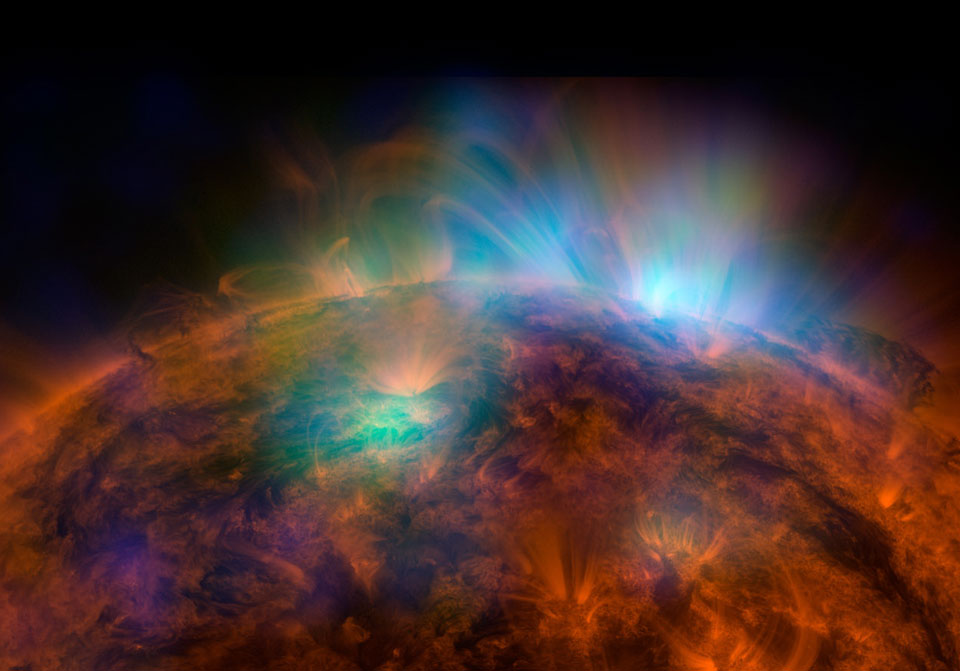
The Sun remains a primary laboratory for understanding the magnetic processes that drive atmospheric heating. While sunspots appear as dark, cooler blemishes on the solar surface, the regions directly above them are paradoxically hundreds of times hotter. High-energy observations from satellites like NuSTAR have begun to pinpoint the source of this energy, pointing toward magnetic reconnection—a process where twisted magnetic field lines snap and reconfigure, releasing energy into the corona.
This magnetic activity is not confined to sunspots. Observations of the chromosphere reveal that localized heating is often linked to the transition of plasma along reconfigured field lines. Similarly, the solar wind, which carries particles out into the solar system at millions of kilometers per hour, originates at the edges of large convection cells. By mapping these magnetic topologies, researchers are connecting the small-scale energy releases in the solar atmosphere to the massive, systemic outflows that shape the heliosphere.
The Sun’s atmosphere is a paradox of temperature, where the outer layers burn far hotter than the surface beneath them.
The Search for Hidden Signals
As our ability to detect gravitational waves improves, the challenge shifts from finding signals to interpreting their nuances. Current models for binary inspirals, particularly those involving spin-inversion, often struggle to distinguish between complex physical motions and simpler, non-evolving scenarios. The degeneracy between these states means that even when we detect a signal, the precise nature of the orbiting bodies remains obscured. To resolve this, researchers are turning to machine learning, employing surrogate waveforms to speed up the computationally expensive process of parameter estimation.
This computational shift is vital as we prepare for a new generation of detectors. Simultaneously, surveys are identifying hundreds of short-period blue compact-binary candidates, many of which could serve as future sources for gravitational-wave observatories. Yet, the data often presents a puzzle: some candidates show modulations that exceed what is expected from binary motion, suggesting that we may be looking at single, rotating magnetic stars rather than pairs. Distinguishing between these possibilities requires a synthesis of astrometry, photometry, and sophisticated waveform analysis, ensuring that we do not mistake a single star's rotation for the dance of a binary system.
Stellar Echoes and Rejuvenated Lives
Asteroseismology has transformed the way we view the interior of stars, turning the tiny variations in their brightness into a diagnostic tool for their deepest cores. In red giants, specific oscillations penetrate to the center, where they intensify before echoing back to the surface. These internal tremors provide a direct measurement of the fusion processes occurring deep within the star, effectively allowing us to map the engine room of a red giant without ever leaving our own solar system.
Other stars defy their own histories through a process of rejuvenation. Blue stragglers, found in ancient globular clusters, appear as young, bright, and hot stars in populations that should have aged long ago. Once thought to be the product of dramatic, high-speed collisions, recent data suggests a more gradual history: these stars are often the result of two orbiting companions slowly coalescing. This slow merger allows them to gain mass and spin, effectively resetting their evolutionary clock and allowing them to persist long after their peers have faded.