Dynamic Rhythms of a Restless Universe
From the flickering star formation of the early universe to the magnetic turbulence of our own sun, modern astrophysics is abandoning static models for a dynamic, time-sensitive view of the cosmos.
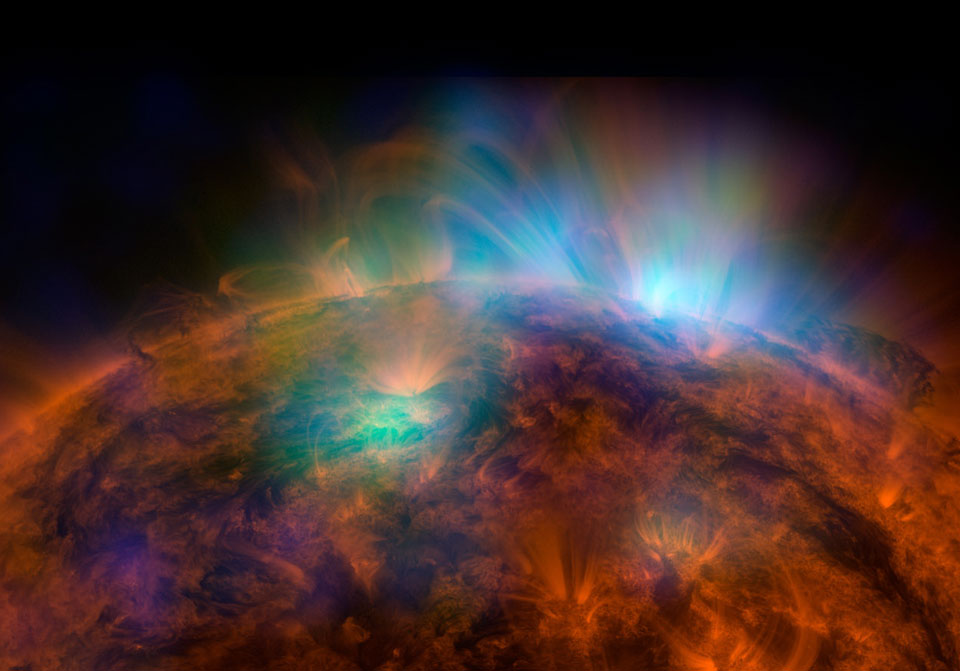
The Flickering Cosmos
Modern astrophysics is less a pursuit of static snapshots and more an exercise in accounting for the restless, shifting nature of the cosmos. Whether looking at the distant, dusty nurseries of galaxies billions of years old or the magnetic turbulence of our own star, researchers are increasingly focused on the stochastic, or flickering, processes that govern evolution. This shift requires not only more sensitive hardware, such as the James Webb Space Telescope or the NuSTAR observatory, but also a fundamental change in how we model the data. We are moving away from simple, equilibrium-based descriptions toward complex simulations that account for the messy, time-dependent reality of cosmic growth and decay.
Modern astrophysics is less a pursuit of static snapshots and more an exercise in accounting for the restless, shifting nature of the cosmos.
Instability in the Early Disc
In the early universe, massive star-forming galaxies were once thought to be the products of violent, late-stage mergers. Recent structural analysis suggests a more nuanced story. By examining these dusty, high-redshift systems, researchers have found that the majority are not colliding behemoths but rather disc-like structures, albeit ones prone to instability. Their gas discs, lacking the stabilizing influence of a mature bulge, are susceptible to minor perturbations that trigger star formation. This instability is not a singular event but a continuous, messy process, where the presence of structured dust often obscures the underlying mechanics of the galaxy’s growth.
Ripples in the Galactic Pond
Closer to home, the Milky Way reveals its own history through vertical oscillations in its disc. These ripples—bending and breathing modes—are the lingering echoes of past interactions, most notably with the Sagittarius dwarf galaxy. Simulations show that these perturbations do not simply fade away; they evolve, with the bending mode decaying into a long-lived breathing mode sustained by spiral arms. This transition serves as a clock for the galaxy, suggesting a significant encounter occurred over 400 million years ago. Meanwhile, edge-on views of other galaxies confirm that such internal sub-structures, from nuclear discs to boxy-peanut bulges, are the primary architects of a disc's vertical evolution.
These ripples are the lingering echoes of past interactions, serving as a clock for the galaxy's history.
The Computational Bottleneck
The challenge of interpreting this data is exacerbated by the sheer volume of information. As detectors like LISA prepare to sense gravitational waves, the need for rapid, accurate waveform generation has spurred the use of machine learning. Surrogate models now allow researchers to bypass the prohibitive computational costs of traditional numerical relativity, though they introduce their own risks. These models must be carefully calibrated to avoid systematic biases that could lead to 'chemical chaos' or false detections. In the case of compact binaries, the degeneracy between different spin-inversion scenarios and no-inversion models remains a significant hurdle, requiring more complete waveforms to truly distinguish between physical effects.
Heating the Solar Atmosphere
The sun, our most accessible laboratory, remains a site of persistent mystery. The corona is hundreds of times hotter than the surface below it, a discrepancy that defies simple convective models. By combining high-resolution spectropolarimetric inversions with multi-height magnetic field extrapolations, physicists are beginning to map the reconnection events that deposit energy into the chromosphere. Figures like Louise Harra have spent careers bridging the gap between these local solar phenomena and the broader space-weather connection, emphasizing that the key to understanding the Sun lies in the precise, multi-wavelength study of its magnetic topology. Whether through X-ray observations of sunspots or the tracking of coronal mass ejections, the focus remains on the interplay between magnetic energy release and the plasma it drives.