Data in the Dark
Modern astrophysics is less about peering through a lens and more about managing the deluge of data from orbital sensors and complex simulations.
The Scale of the Survey
The sheer volume of information provided by missions like Gaia has fundamentally altered the pace of stellar research. Where astronomers once focused on individual targets, they now contend with catalogs numbering in the hundreds of thousands. By combining Gaia’s precise astrometry with high-cadence photometry from the Transiting Exoplanet Survey Satellite, researchers have begun to map the internal lives of intermediate-mass stars with unprecedented clarity. This shift allows for the systematic study of near-core rotation, revealing how these stars evolve over the main sequence and how their internal structures change as they age.
The sky is no longer a static backdrop but a turbulent, shifting laboratory that demands we refine our tools before we can hope to understand it.
Dynamics of the Galactic Disc
Beyond the individual star, our own galaxy and those far beyond it are proving to be far more dynamic than static models once suggested. Simulations of the Milky Way’s disc reveal that vertical oscillations—bending and breathing modes—are not merely intrinsic properties but are often the result of external gravitational tugs from satellite galaxies like Sagittarius. Similarly, observations of massive, dusty star-forming galaxies at high redshift suggest that these systems are not necessarily the chaotic, late-stage mergers once assumed. Instead, they often maintain stable disc-like structures, with their perceived morphological complexity arising from significant, structured dust content rather than catastrophic collisions.
The Solar Mystery
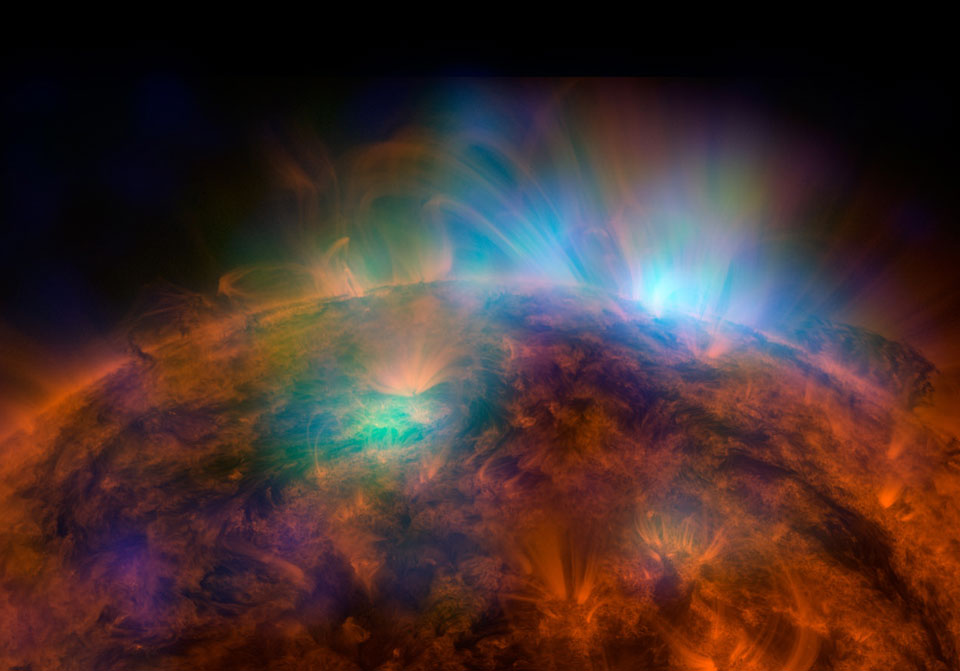
The Sun remains a primary laboratory for understanding plasma physics, particularly the enduring mystery of why its outer atmosphere is drastically hotter than its surface. Features like 'Solar Moss' and the intense X-ray emissions detected by NuSTAR above sunspots indicate that magnetic reconnection and nanoflares are likely drivers of this extreme heating. Physicists like Louise Harra have dedicated careers to these phenomena, utilizing spectroscopic instruments on missions like Hinode and the Solar Orbiter to bridge the gap between magnetic topology and energy release, proving that the Sun’s corona is a site of constant, violent reconfiguration.
We are learning that the most profound insights into the Sun's atmosphere may lie in the smallest, most fleeting bursts of energy.
Computational Frontiers
As we look toward the next generation of detectors, the challenge shifts from gathering data to interpreting it. In the study of protoplanetary discs, researchers are finding that the presence of gaps does not simply block the flow of material, as once hypothesized, but instead creates a complex chemical environment that influences the building blocks of terrestrial planets. Meanwhile, in gravitational-wave astronomy, the complexity of waveforms—particularly those involving spin inversions or eccentric orbits—threatens to overwhelm current computational models. To keep pace, the field is turning to machine-learning surrogates, which promise to accelerate parameter estimation even as they introduce new challenges in managing systematic bias and ensuring the accuracy of our theoretical predictions.