Cosmic Dynamics in Modern Observation
Recent advances in observational technology and computational modeling are revealing that galaxies and stars are far more dynamic, interconnected, and complex than previous models suggested.
The Fluidity of Form
The study of galactic anatomy has moved beyond simple classification. Where astronomers once sought to categorize galaxies into rigid bins, current research emphasizes the fluid, often turbulent nature of their internal structures. By examining massive, dusty star-forming galaxies at high redshifts, researchers have found that these systems frequently defy the expectation of violent, chaotic mergers. Instead, many exhibit stable, disc-like morphologies, albeit with subtle instabilities that suggest a quieter, more secular evolution than previously assumed. This shift in perspective is mirrored in the study of local, edge-on galaxies, where sophisticated pipelines now allow for the mapping of kinematic sub-structures. These tools reveal that even the most familiar galactic shapes often mask complex internal dynamics, such as nuclear discs and stellar bars, which dictate the long-term evolution of the system without requiring cataclysmic external intervention.
The modern galaxy is less a static monument than a restless, shifting assembly of gas and light.
Magnetic Echoes and Galactic Ripples
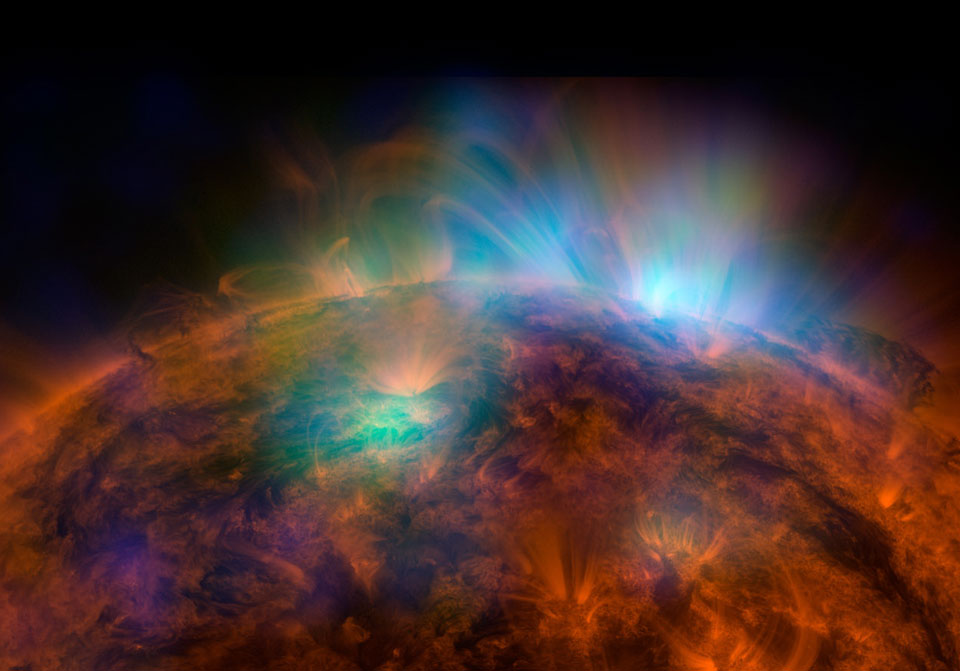
The sun, our nearest laboratory, serves as a primary site for testing theories of magnetic energy release. The persistent mystery of why the solar corona remains significantly hotter than the surface below has spurred targeted observations, such as those from the NuSTAR satellite. These data suggest that magnetic reconnection—the snapping and reconfiguring of magnetic field lines—acts as a furnace, driving energy into the chromosphere. This process is not isolated to the sun; similar dynamics of vertical oscillation and wave propagation are observed in the Milky Way itself. Simulations of our own galaxy suggest that interactions with satellite neighbors, such as the Sagittarius dwarf, excite bending and breathing modes in the galactic disc. These ripples, spreading through the stellar population, illustrate that the galaxy is constantly responding to both internal magnetic stresses and external gravitational tugs.
The Life and Rejuvenation of Stars
Stellar evolution is fundamentally a story of mass loss and transformation. For massive stars, the rate at which they shed material is a critical variable, dictated by their chemical composition or metallicity. Recent analysis of O-type stars in the Small Magellanic Cloud highlights that this mass-loss process is far more nuanced than early models suggested, with clumping properties and luminosity-dependent scaling adding layers of complexity to our understanding of how stars die. This life cycle is equally mysterious in denser environments like globular clusters. The presence of blue stragglers—stars that appear younger and hotter than their peers—long challenged the assumption that all stars in a cluster formed simultaneously. We now understand these objects not as anomalies of birth, but as the results of slow, gravitational coalescence, proving that even in the most ancient stellar populations, the process of rejuvenation continues.
Signals in the Noise
The era of gravitational-wave astronomy has brought a new set of computational hurdles. As we prepare for more sensitive detectors, the sheer volume of expected data necessitates a reliance on machine learning to generate surrogate waveforms. These models allow for the rapid parameter estimation required to interpret binary coalescences, though they introduce the risk of systematic bias that researchers must carefully calibrate. Simultaneously, the search for compact binaries using Gaia and ZTF data shows that the line between a binary system and a single, magnetically active star is remarkably thin. Distinguishing between these possibilities requires not just more data, but a deeper refinement of the waveforms we use to interpret the universe's most subtle vibrations.
As the volume of data grows, the challenge shifts from finding the signals to distinguishing them from the noise of our own assumptions.
Probing the Interior
The tools of modern astrophysics, from the asteroseismology that allows us to probe the core of a red giant to the sophisticated imaging spectrometers developed by physicists like Louise Harra, are transforming our view of the cosmos. By timing the oscillations of stars or mapping the solar wind, we are moving toward a more integrated understanding of stellar and galactic behavior. These techniques allow us to look past the surface of celestial objects, turning what was once the domain of theoretical speculation into a measurable, physical reality.