Stellar Evolution and Final Collapses
From the gentle shedding of planetary nebulae to the violent collapse of massive stars, the life cycles of stars reveal a universe in constant, shifting transition.
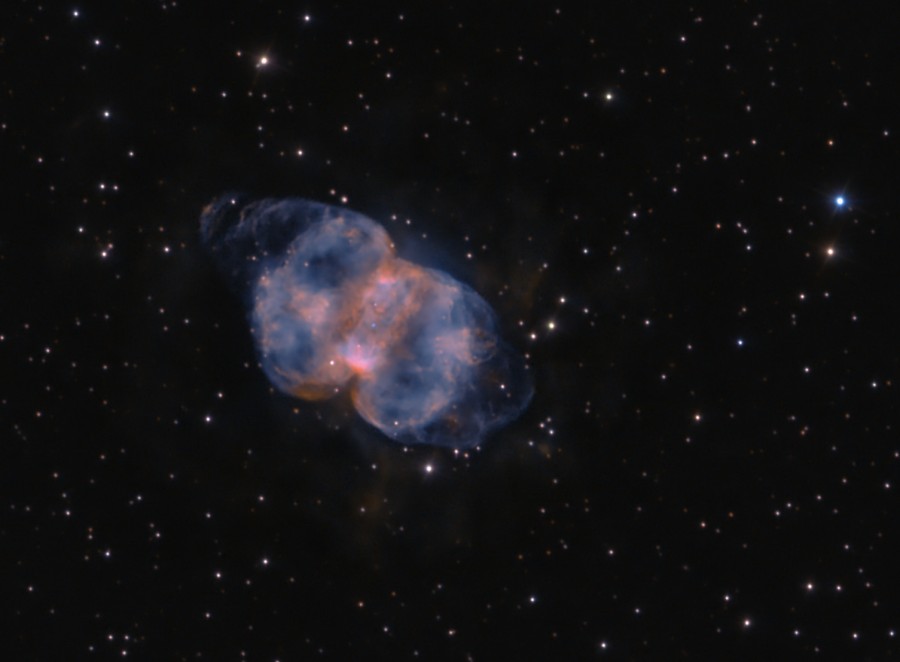
The Furnace and the Shroud
Stellar life is defined by a persistent, losing battle against gravity. For stars like our own, the endgame is a slow shedding of layers. As the core exhausts its hydrogen, the star expands, eventually casting off its outer envelope to create a planetary nebula—a luminous, ghostly shell of gas that lingers for a few thousand years. These objects, such as the Little Dumbbell Nebula, are not merely aesthetic curiosities; they are the final signatures of solar-type stars, marking the transition from a burning furnace to a cooling, dense white dwarf. In the vastness of the galaxy, these nebulae often appear as foreground interlopers, drifting in front of younger, more crowded star clusters, reminding us that the life of a star is measured in stages that rarely overlap in a single field of view.
Stellar life is defined by a persistent, losing battle against gravity.
Dust in the Wind
In the dwarf galaxy NGC 6822, the process of stellar death takes on a more industrial character. Recent deep-space observations have mapped the population of evolved stars, revealing a complex interplay between carbon-rich and oxygen-rich giants. Despite the galaxy's low metallicity, these stars act as significant engines of dust production, returning material to the interstellar medium at a steady rate. The presence of oxygen-rich stars, in particular, suggests that intermediate-mass stars are undergoing hot-bottom burning, a process that enriches the surrounding environment even as the stars themselves approach their final decline.
The Unstable Cradle
Before a star reaches its twilight, it must survive its infancy. Young stellar objects, such as T Tauri stars, are defined by their chaotic accretion of matter from surrounding disks. This process is far from uniform; it is a violent, episodic affair. Magnetospheric accretion—the funneling of gas onto the star along magnetic field lines—creates hotspots that persist for rotations, yet the underlying flow is often unstable. Observations of stars like TW Hya show that mass accretion rates fluctuate significantly over time, while other systems undergo dramatic bursts of activity, potentially triggered by the gravitational influence of hidden companions.
This early period is also a test of scaling. While the magnetospheric model works well for low-mass stars, higher-mass Herbig Ae/Be stars present a murkier picture. Their accretion signatures do not differ significantly between magnetic and non-magnetic examples, suggesting that the tidy paradigms developed for smaller stars may not apply as we move up the mass scale. The magnetic fields of these young stars appear to be more complex and less dominant than once assumed, leaving the mechanisms of their growth open to debate.
The life of a star is measured in stages that rarely overlap in a single field of view.
The Petit Four of Collapse
When a massive star finally exhausts its fuel, the collapse is cataclysmic. The iron core, no longer supported by fusion, implodes under its own weight, triggering a supernova that scatters heavy elements across the galaxy. What remains is a neutron star—a sphere of unimaginable density, where the laws of physics are pushed to their absolute limit. These remnants are not static; they are the cooling embers of a violent birth, often retaining the angular momentum of their progenitors and spinning at dizzying speeds.
Deep within the core of a proto-neutron star, the conditions are so extreme that hadronic matter may undergo a phase transition into a color-superconducting state. This hypothetical state suggests a variety of evolutionary paths: some stars may linger in this phase, while others might find it fleeting or vanish entirely as the star cools and settles into its final, dense configuration. These scenarios represent the final, hidden chapters of stellar evolution, occurring in the seconds after a supernova, long before the resulting remnant becomes a pulsar or, if the mass is sufficient, collapses further into a black hole.