Stellar Origins Through Infrared Observation
New infrared observations are revealing how stars emerge from their cold, dark cocoons to reshape the chemical landscape of the galaxy.
The Cradle in the Dark
Star formation is a process of profound concealment. The birthplaces of stars, known as infrared dark clouds, are dense, cold, and opaque to the visible light that dominates our daily experience. Within these silent, frigid reservoirs, gravity begins its slow, relentless work, pulling together gas and dust into clumps that will eventually ignite. These regions are not merely static monuments of gas; they are dynamic, turbulent environments where the initial conditions of future solar systems are quietly established.
Star formation is a process of profound concealment.
Spectroscopy and the Chemistry of Beginnings
With the arrival of the James Webb Space Telescope, our ability to peer into these obscured nurseries has shifted from mere detection to precise chemical mapping. By utilizing mid-infrared spectroscopy, researchers can now identify the molecular signatures of gas-phase species—such as water, carbon dioxide, and methane—that were previously inaccessible. These observations reveal a surprising chemical richness in low-mass protostellar systems, providing a window into the volatile environments where planetary materials first coalesce. The temperature of these gases, often ranging between 100 and 300 Kelvin, suggests a far more temperate beginning than the intense heat found in more evolved stellar systems.
Isotopes as Cosmic Fingerprints
The chemical evolution of a protostar is further illuminated by the study of isotopes. By measuring the ratios of carbon-12 to carbon-13 within the ice mantles of protostellar envelopes, astronomers can trace the history of the material from the interstellar medium to the forming disk. These ratios act as a sensitive probe of the local chemical environment, revealing that the conditions within these envelopes are not uniform. Variations in isotope abundance from one source to the next suggest that each stellar nursery possesses a distinct chemical identity, shaped by its unique history and local surroundings.
These ratios act as a sensitive probe of the local chemical environment, revealing that the conditions within these envelopes are not uniform.
From Ice to Gas
A central question in the study of star formation is how complex organic molecules transition from the solid ice phase to the gas phase. Recent findings indicate that many of these molecules, including methanol and various oxygen-bearing compounds, are inherited directly from the ice mantles that coat dust grains in the cold, dense envelope. As the protostar warms its immediate surroundings, these ices sublimate, enriching the gas with the building blocks of potential prebiotic chemistry. This transition is not merely a physical change but a critical stage in the chemical maturation of a nascent solar system.
Feedback and the Sculpting of Space
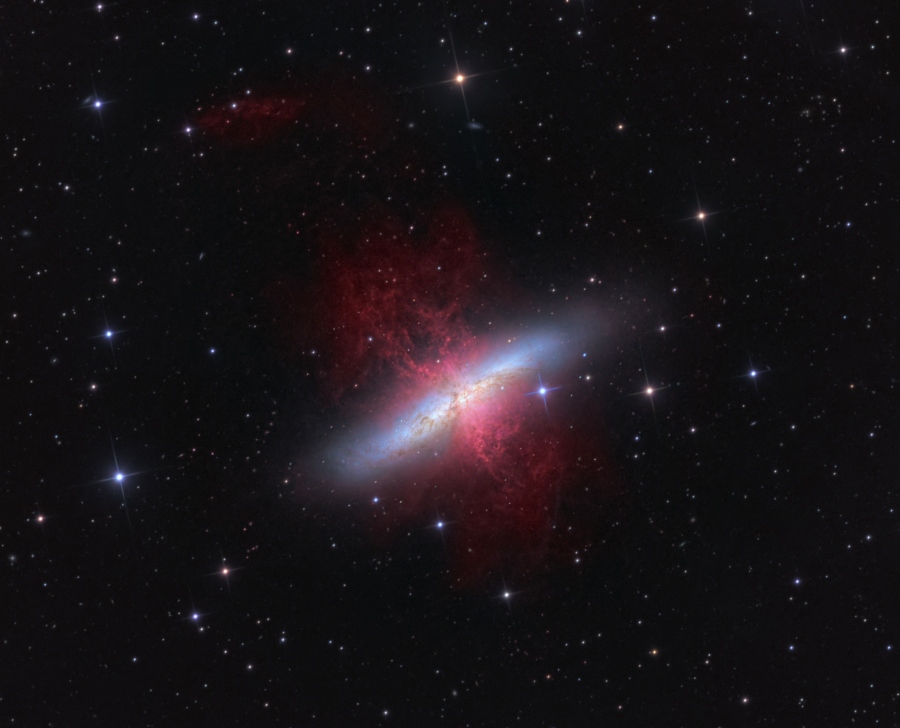
Once a star begins to form, it does not remain a passive inhabitant of its cloud. Through powerful jets, winds, and radiation, the newborn star begins to interact with its environment, clearing out cavities and sculpting the surrounding gas into intricate, glowing structures. In massive star-forming complexes, this feedback can trigger further generations of stars, as shock waves sweep through and compress nearby molecular material. Whether viewed as the yellow balls of an early massive protostar or the expansive, ionized filaments of a starburst galaxy, the impact of these young stars is a defining force in the evolution of the interstellar medium.