Molecular Origins of Planetary Systems
New infrared observations are revealing that the chemical complexity of a planetary system begins deep within the cold, turbulent cradles of newborn stars.
The Sculptors of the Void
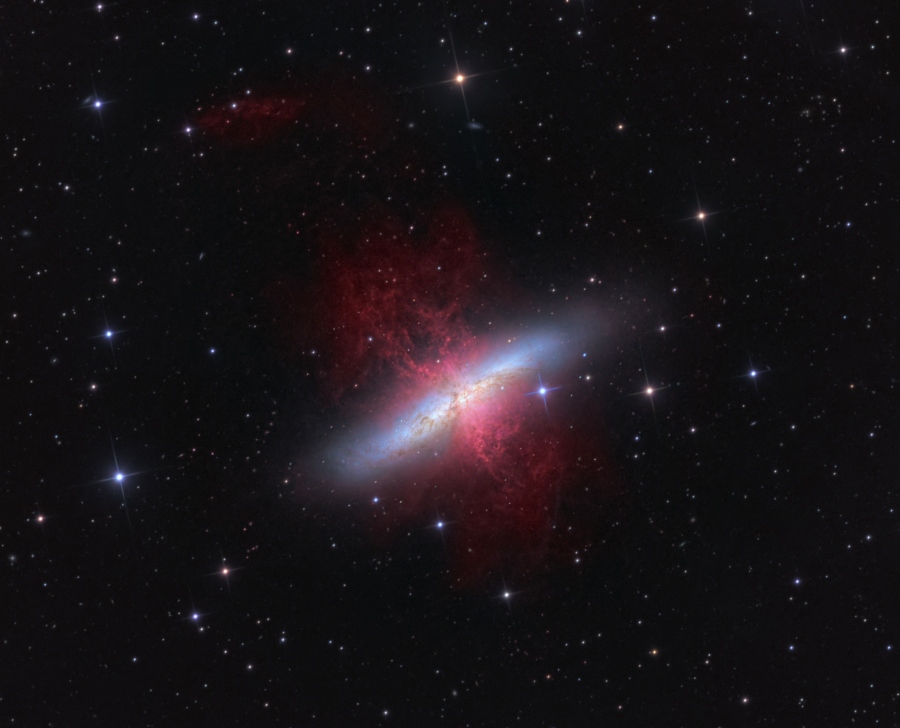
Star formation is rarely a quiet affair. It is a process of violent compression, where the cold, dark reservoirs of interstellar gas are shoved into density by shockwaves from supernovae or the relentless pressure of stellar winds. In regions like the Tarantula Nebula or the Cigar Galaxy, this activity reaches a fever pitch, creating vast, glowing filaments of ionized hydrogen that stretch across thousands of light-years. These nebulae are not merely static backdrops; they are active, sculptural environments where massive stars emerge to carve out cavities in their natal clouds, effectively regulating their own birth through the radiation they emit.
Star formation is a process of violent compression, where cold, dark reservoirs of interstellar gas are shoved into density by shockwaves.
The Yellow Ball Phase
Before a massive star fully clears its surroundings, it leaves behind a distinct signature in the infrared spectrum. In the W33 complex, observers identified curious, compact features dubbed yellow balls. These are not merely visual artifacts but markers of a specific, fleeting developmental stage. By mapping infrared wavelengths to visible colors, researchers found that these balls represent the moment before a newborn star creates a bubble in its environment, with the yellow hue emerging from the overlap of dust and organic molecules. This discovery highlights how the public, through crowdsourcing, can help identify the transitional phases that define the life cycle of a star.
Tracing the Isotopic Fingerprint
Modern instrumentation, specifically the James Webb Space Telescope, has shifted the focus from the grand scale of nebulae to the intimate chemistry of protostellar envelopes. By analyzing the absorption features of carbon monoxide and carbon dioxide ice, researchers can now trace the chemical history of a system as it moves from a cold, dense cloud toward the formation of a disk. This data reveals that the chemical conditions within these envelopes are far from uniform, showing significant variability between sources. These variations suggest that the local environment of a protostar is uniquely imprinted on the material that will eventually compose its planetary system.
The local environment of a protostar is uniquely imprinted on the material that will eventually compose its planetary system.
From Ice to Atmosphere
The transition from ice to gas is perhaps the most critical juncture for complex organic molecules. For years, methanol was the only complex organic molecule firmly detected in interstellar ices. Recent observations have expanded this inventory to include a variety of oxygen-bearing compounds, such as ethanol and methyl formate. By comparing the column densities of these molecules in both the solid ice and the surrounding gas, scientists are beginning to map the inheritance of chemical complexity. Some molecules appear to transition directly from ice to gas, while others suggest a more intricate chemical evolution, indicating that the building blocks of potential planetary systems are forged long before a star reaches maturity.