Cosmic Inventories: Precision in the Void
From the icy chemistry of distant molecular clouds to the mechanical relics left on the lunar surface, our reach into the void remains a study in persistence and precision.
The Chemistry of Cold Places
The modern study of space is increasingly defined by the granular. Where early exploration focused on the grand sweep of planetary flybys, contemporary efforts are preoccupied with the molecular. Recent observations by the James Webb Space Telescope have turned the Chamaeleon I molecular cloud into a laboratory for ice chemistry. Researchers have identified complex mixtures of water, methanol, and ammonia hydrates, providing a clearer picture of the conditions that precede the formation of stars and planets. By deploying sophisticated astrochemical models, scientists are testing how these volatile ices form, concluding that the hydrogenation of carbon monoxide remains the primary engine for methanol production in these frigid, dense environments.
We are not merely observing the cosmos; we are cataloging the very ingredients of potential worlds.
Inventories of the Protostellar
This focus on chemical inventory extends to the protostellar systems themselves. Observations of the binary system Ced 110 IRS4 have revealed a rich collection of ices, including methane, sulfur dioxide, and various organic molecules. These findings suggest that the raw materials for habitable worlds are not rare accidents but common features of star-forming regions. By comparing these distant inventories with the background stars of the same cloud, astronomers are beginning to map the thermal and chemical evolution of these stellar nurseries, identifying the subtle signatures of processing that occur as a protostar begins to heat its surroundings.
The Mechanics of Rubble
Closer to home, the study of asteroids has shifted from simple observation to the forensic analysis of rubble piles. The DART mission’s encounter with the binary system Didymos and its moonlet, Dimorphos, provided a rare opportunity to examine the mechanics of fragmentation. The distribution of boulders on their surfaces suggests that these bodies are not solid monoliths but reaccumulated fragments from the destruction of larger progenitors. This process of spin-up and mass shedding appears to be a fundamental mechanism in the creation of binary asteroid systems, leaving behind a surface density of blocks that serves as a record of their chaotic assembly.
The debris of a collision is not just waste; it is a map of the system's violent history.
Relics and Voyagers
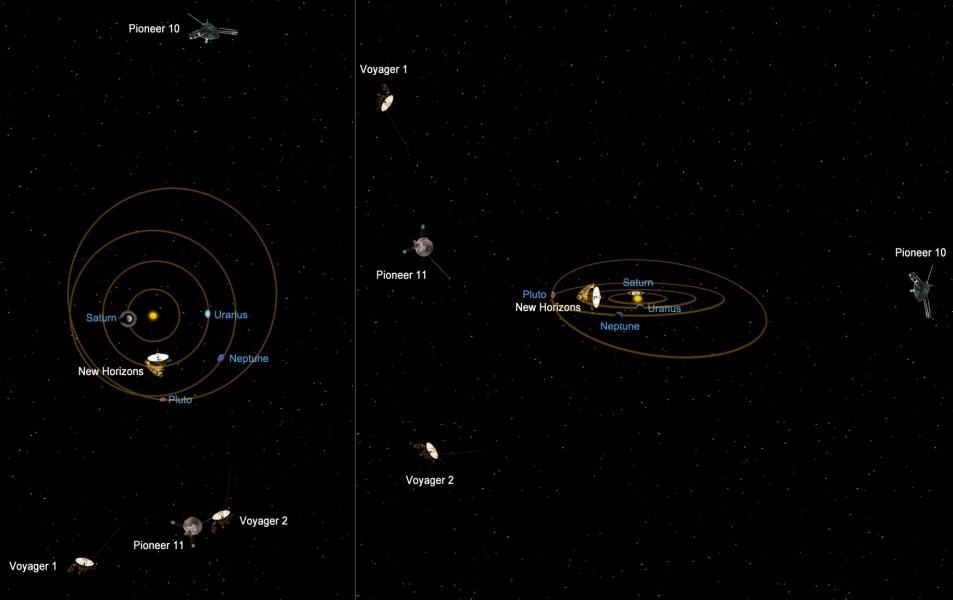
Our presence in space is marked by both the active and the abandoned. While current missions like the James Webb Space Telescope utilize Earth-trailing orbits to escape the infrared interference of our planet, older relics continue to serve unexpected roles. The Soviet Lunokhod 1 rover, dormant since 1971, has been repurposed as a passive laser reflector, allowing scientists to measure the Moon’s orbit with millimeter precision. Meanwhile, the pioneers of the deep-space era—Voyager 1, Voyager 2, and Pioneer 10—continue their silent transit into interstellar space. These craft, now billions of kilometers from the Sun, carry the physical markers of their origin, drifting as slow-moving emissaries into the dark.
Miniaturizing the Constellation
The future of this exploration lies in miniaturization. To understand the complex interplay between the Sun and Earth, NASA is developing constellations of nano-satellites, each weighing no more than 10 kilograms. These autonomous, radiation-hardened units aim to provide simultaneous, multi-point measurements that were previously impossible with single, large-scale observatories. By partnering with private industry, the agency is refining the technologies—from miniaturized propulsion to compact electronics—that will allow us to monitor the solar environment with unprecedented granularity, ensuring that our reach into space remains both efficient and expansive.