Solar Ledger of the Outer Planets
From the rain of helium in gas giants to the salt-crusted surface of dwarf planets, the solar system remains a ledger of unfinished business.
The Internal Weather of Giants
The massive spheres of Jupiter and Saturn are not merely static gas giants; they are engines of internal transformation. Deep within their interiors, the extreme pressures and temperatures force a phase separation between hydrogen and helium, a process known as helium rain. As helium droplets condense and fall toward the core, they release gravitational energy that influences the planets' long-term cooling and evolution. Recent modeling suggests that Saturn, in particular, possesses a significant helium gradient and a vast internal ocean of the element. This internal precipitation is not uniform across the gas giants, with Jupiter showing more modest de-mixing. Understanding these dynamics is essential for refining the hydrogen-helium equation of state, which remains a primary challenge for planetary scientists attempting to map the hidden structures of our largest neighbors.
The massive spheres of Jupiter and Saturn are not merely static gas giants; they are engines of internal transformation.
Atmospheric Dynamics at the Edge
Beyond the gas giants, the solar system exhibits a variety of atmospheric behaviors driven by seasonal shifts and complex chemistry. On Neptune, the arrival of spring in the southern hemisphere—a season lasting four decades—has triggered a noticeable increase in reflective cloud bands, a response to sunlight despite its extreme distance. Similar complexities exist in the atmospheres of brown dwarfs, which serve as massive analogues for giant exoplanets. By employing a technique called Differential Molecular Rotational Broadening, researchers have identified latitudinal chemical variations on these bodies, such as the depletion of methane and ammonia at low latitudes. This suggests that even in the absence of a host star's influence, these worlds maintain intricate, equator-to-pole thermal gradients that dictate their cloud formation and chemical composition.
The Salt and the Stone
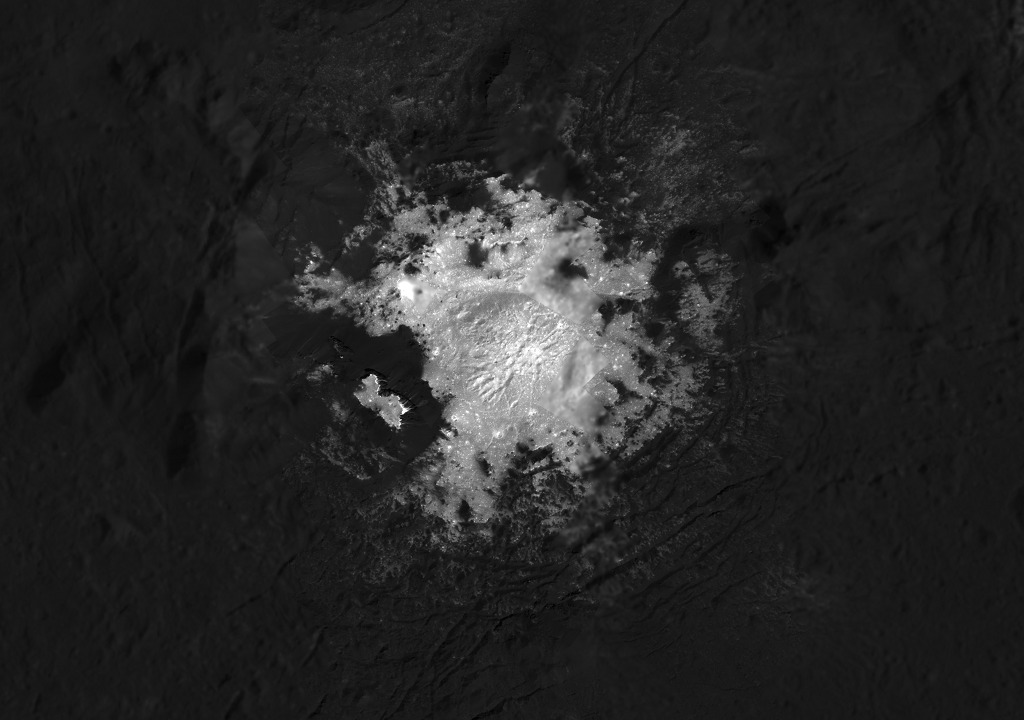
The smaller bodies of the solar system offer a different kind of record, one etched in salt and crystalline mineral structures. On Ceres, the dwarf planet’s brightest feature, Cerealia Facula, is not a patch of ice but a residue of sodium carbonate and ammonium chloride, likely deposited by a slushy brine from beneath the crust. This salty crust provides a stark contrast to the iron-rich meteorites that fall to Earth. These fragments, such as the Canyon Diablo iron octahedrite, carry the Widmanstatten pattern—an intricate interweaving of kamacite and taenite that only emerges as molten metal cools over vast timescales. These patterns are a physical history of the asteroid’s thermal life, frozen into a crystalline lattice long before the fragment encountered Earth's atmosphere.
These fragments carry the Widmanstatten pattern—an intricate interweaving of minerals that only emerges as molten metal cools over vast timescales.
The Farside Dichotomy
The Moon serves as a laboratory for understanding the space environment, with its two hemispheres recording different histories of exposure. Samples returned from the lunar farside by the Chang’e-6 mission reveal a distinct lack of the vapor deposition layers common to the nearside, alongside thinner amorphized layers and larger nano-phase metallic iron grains. These differences indicate that the solar wind is the primary agent of space weathering at the sampling site, exerting a greater influence than micrometeorite impacts. This dichotomy highlights how the lunar surface acts as a sensitive detector for the solar environment, preserving evidence of its exposure in the very structure of its regolith.
Archives of the Outer Reaches
The outer solar system, specifically the Kuiper belt, remains a vast repository of primordial material. Extending from the orbit of Neptune, this disc of frozen volatiles—methane, ammonia, and water—contains the remnants of the solar nebula that failed to coalesce into planets. While the belt was once thought to be the primary source of all short-period comets, modern studies suggest that the scattered disc, shaped by Neptune’s outward migration billions of years ago, is the more active zone for these objects. From the vantage point of Voyager 1, looking back at the solar system from four billion miles away, the planets appear as mere points in a larger, mostly empty expanse. This perspective underscores the reality that the solar system is not just a collection of planets, but a complex, evolving structure of debris, ice, and gas, much of which remains in the cold, stable orbit of the outer reaches.