Cosmic Origins Reconstructed from Meteorite Signatures
By analyzing the isotopic signatures of meteorites and the shifting landscapes of distant moons, we are slowly reconstructing the chaotic origins of our planetary neighborhood.
The Inventory of the Void
The Solar System is, in its most fundamental sense, a collection of leftovers. When Voyager 1 turned its camera back toward the Sun in 1990, it captured a portrait of a neighborhood defined by what remained after the primary construction of the planets. This debris field is not merely a collection of rocks but a ledger of the early solar nebula. Beyond the reach of Neptune, the Kuiper belt serves as a vast, frozen archive of these primordial materials, containing objects that never coalesced into larger worlds. These icy remnants, ranging from dwarf planets to countless smaller bodies, represent the raw, unrefined state of the system as it existed billions of years ago.
We are cataloging the debris of a chaotic beginning to understand the quiet order of our present.
Genetic Markers in Stone
Meteorites falling to Earth act as messengers from this distant past, carrying isotopic signatures that reveal the distinct environments in which they were forged. Recent analysis of iron meteorites has confirmed a sharp division between non-carbonaceous and carbonaceous parent bodies. These groups reflect different chemical reservoirs within the early nebula, with carbonaceous bodies showing signs of more oxidizing conditions and a distinct history of accretion. By examining the isotopic anomalies in these samples—whether they are unusual H4 chondrites found in the Antarctic ice or ungrouped iron fragments—researchers can trace the cooling and core formation of bodies that have long since been shattered or scattered.
The Fluidity of Frozen Worlds
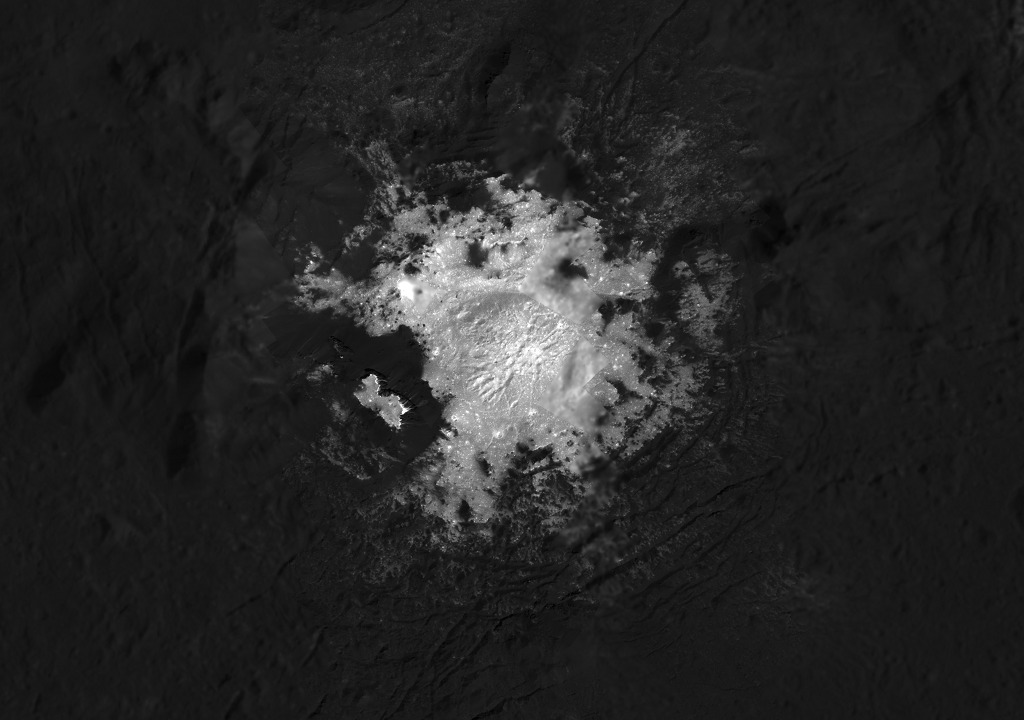
The outer reaches of the system are home to worlds that defy the expectation of static, dead rock. On Ceres, the bright deposits of Cerealia Facula are not ice but the salty residue of brine that once welled up from beneath the crust. Similarly, moons like Callisto, Ganymede, and Europa suggest that beneath their battered, cratered exteriors may lie hidden seas. These bodies are not merely cold spheres; they are dynamic environments where internal heat and liquid water continue to shape the geology, hinting at the potential for complex chemistry far from the warmth of the Sun.
The surface of a moon is often a mask for a more volatile interior.
Atmospheres of Violence and Change
Planetary science is as much about the observation of fleeting atmospheric turbulence as it is about the study of ancient stone. In 2010, a storm on Saturn erupted with such ferocity that it circled the entire planet, a reminder of the massive, shifting energy that governs gas giants. Such events are tied to seasonal cycles, revealing the interplay between internal heat and solar influence. Meanwhile, on Mars, the Perseverance rover investigates the sedimentary layers of Jezero crater, seeking evidence of a time when the planet was wet and potentially habitable. These two extremes—the raging storms of the gas giants and the quiet, dried-up riverbeds of the red planet—frame our understanding of how planetary climates evolve, stabilize, or collapse over eons.