Cosmic Signals and Stellar History
From the first light of the early universe to the turbulent surfaces of nearby stars, the history of the cosmos is written in signals that require both ingenuity and immense technical precision to decode.
The Deepest Light
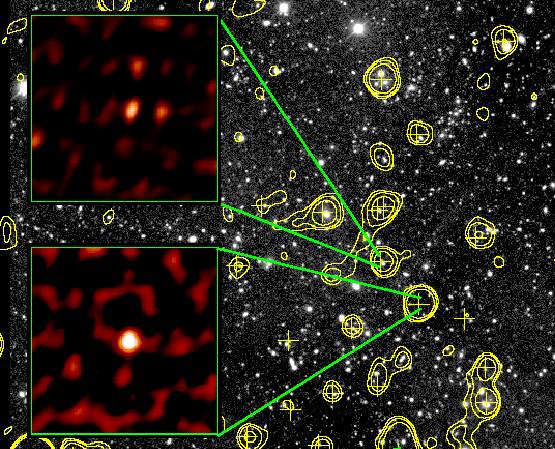
The history of the universe is written in photons that have traveled for billions of years to reach our instruments. To see further is to see earlier, a task that requires both immense light-gathering power and the ability to filter out the noise of our own local environment. The MIRI Deep Imaging Survey, utilizing the James Webb Space Telescope, has pushed this boundary by capturing mid-infrared wavelengths that were previously inaccessible, allowing us to peer through the cosmic dust that obscures the birth of galaxies. By integrating light for over 40 hours, astronomers have identified thousands of sources, some dating back to the epoch when the first stars were beginning to coalesce.
This pursuit of the distant past often relies on nature’s own magnifying glass. When a massive galaxy cluster sits between us and a far-flung object, its gravity warps spacetime, acting as a lens that can brighten a single, otherwise invisible star by thousands of times. This gravitational lensing has brought objects like Earendel into our field of view, providing a rare glimpse of individual stellar entities from the early universe. Such observations are not merely about distance; they are about mapping the evolution of the cosmos from its infancy to the complex structures we see today.
To see further is to see earlier, a task that requires both immense light-gathering power and the ability to filter out the noise of our own local environment.
The Anatomy of a Star
While some look to the edge of the observable universe, others focus on the turbulent, nearby laboratories of individual stars. Massive, evolved stars like the yellow hypergiant IRC +10420 or the red supergiant Betelgeuse are not static spheres of light; they are dynamic, shedding mass and creating complex circumstellar environments. Probing these regions requires techniques that transcend standard imaging, such as long-baseline interferometry, which combines signals from multiple telescopes to achieve resolutions that would otherwise require a mirror the size of a continent.
These methods reveal that the surfaces of stars are far from uniform. Betelgeuse, for example, displays persistent hot patches and convective cells that suggest a violent, churning interior. In binary systems like IP Pegasi, the interaction between stars creates accretion disks that can be mapped through doppler tomography, a process that converts velocity measurements into spatial patterns. These techniques allow us to see the spiral arms and gas flows that define the life and death of stars, proving that even the most familiar objects in our night sky hold secrets that only high-resolution observation can reveal.
Patterns in the Dust
The formation of planetary systems and the chemical history of the galaxy are both recorded in the distribution of dust and the composition of ancient stars. In the eDisk survey, researchers have systematically analyzed protostellar disks, finding that while many appear smooth at current resolutions, others possess subtle asymmetries that hint at the early stages of planet formation. These disks are the nurseries of future solar systems, and their structure provides a timeline for how matter collapses and organizes itself around a central star.
Simultaneously, the Pristine survey has utilized the chemical signatures of red giant stars to trace the history of the Milky Way. By identifying stars with extremely low metal content, astronomers can map the remnants of ancient galactic mergers. These stars act as fossils, carrying the chemical imprint of the environments in which they were born. By linking their kinematics to known accretion events, we can reconstruct the violent, hierarchical process that built our own galaxy, layer by layer, over billions of years.
These stars act as fossils, carrying the chemical imprint of the environments in which they were born.
The Limits of Detection
Observational astronomy is frequently a struggle against the limitations of our current technology. Whether it is a candidate binary black hole system whose spectral anomalies might simply be the result of a single, reddened AGN, or the mysterious transients found in century-old photographic plates, the interpretation of data is always subject to the precision of our models. As we refine our instruments, we often find that what appeared to be a singular phenomenon is actually a complex interplay of physical processes.
Looking ahead, the development of next-generation gravitational wave observatories promises to open an entirely new channel for exploration. By detecting the ripples in spacetime caused by merging black holes and neutron stars, these networks will provide a way to study the universe that is entirely independent of light. This multimessenger approach—combining electromagnetic observations with gravitational data—represents the next frontier, allowing us to test fundamental physics in regimes that were once thought to be beyond the reach of human inquiry.