Cosmic Observation Through Precision Instruments
From the surface of a red supergiant to the edge of the observable universe, our view of the cosmos is defined by the tools we use to filter the noise.
The Geometry of Light
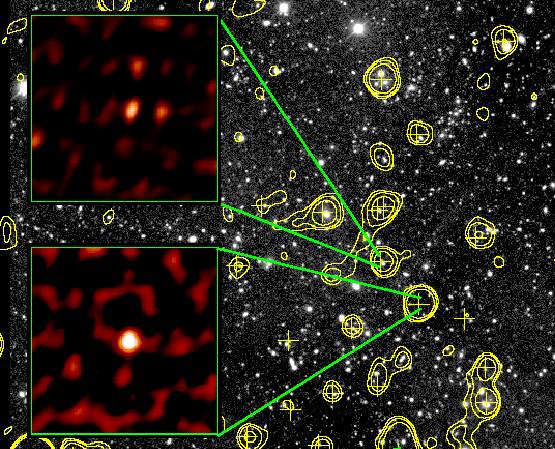
The history of astronomy is often told as a progression of light-gathering power, but it is more accurately a history of resolution—the ability to distinguish one point of light from another. When we look at the sky, we are not merely collecting photons; we are attempting to reconstruct a scene from fragmented data. Whether using the long-baseline interferometry of the VLTI to map the inner wind of a yellow hypergiant or the radio networks that pierce through interstellar dust, the challenge remains the same: how to resolve the structure of an object that is, for all intents and purposes, a point source.
We are not merely collecting photons; we are attempting to reconstruct a scene from fragmented data.
Time as a Dimension
Modern observation relies heavily on the marriage of archival data and rapid follow-up. By revisiting the Kepler field with the TESS telescope, researchers have extended the baseline of observation for hierarchical triple star systems, allowing for the identification of longer-period orbits that were invisible to shorter missions. This temporal depth is as vital as spatial resolution. It allows us to see not just the state of a system, but its evolution—whether it is the subtle shift in a star's eclipse timing or the changing surface features of Betelgeuse, which remain stubbornly stable over years despite the chaotic convective processes beneath.
Mapping the Invisible
Not all cosmic structures reveal themselves through direct imaging. For systems like the binary star IP Pegasi, the accretion disk is far too small to be resolved by any current telescope. Instead, astronomers employ Doppler tomography, a technique that maps the velocity of gas as it spirals toward a white dwarf. By measuring the light emitted by hydrogen at different velocities, researchers can infer the existence of spiral arms that are physically invisible to the lens. This is the triumph of indirect observation: constructing a physical map from a spectral signature.
This is the triumph of indirect observation: constructing a physical map from a spectral signature.
The Multi-Messenger Frontier
The frontier of observation often lies in the rare and the extreme. The detection of a neutrino from a distant blazar, corroborated by a global network of gamma-ray observatories, represents a shift toward multi-messenger astronomy. Similarly, the study of high-redshift starburst galaxies like J1316+2614 requires us to reconcile the extreme luminosity of a young stellar population with the physics of gas expulsion. In these cases, the data is often noisy and the interpretations subject to the limitations of our models, yet they provide the only window into the most energetic events in the universe.
The Archive and the Unknown
As we refine our techniques, we inevitably encounter the limits of our assumptions. The Pristine survey’s success in identifying metal-poor stars demonstrates how photometric metallicities can be validated by spectroscopic follow-up, turning millions of data points into a coherent map of galactic accretion. Yet, other phenomena remain elusive. The mysterious transients found in early sky surveys, sometimes linked to speculative dark matter models, serve as a reminder that the archive is not just a record of what we know, but a repository of what we have yet to explain. Observation is a constant negotiation between the signal we seek and the noise we inherit.