Beyond the Aperture
By synthesizing data across the electromagnetic spectrum, modern astronomy is moving beyond simple snapshots to map the complex, hidden dynamics of the cosmos.
Peeling Back the Veil
Modern observational astronomy relies on the art of peeling back the layers of the cosmos. By moving beyond the visible spectrum into infrared and radio wavelengths, researchers can now penetrate the dense, obscuring clouds of dust that once rendered the most active regions of space invisible. The MIRI Deep Imaging Survey, for instance, utilizes the James Webb Space Telescope to capture wavelengths beyond 5 micrometers, granting us a view of mature stellar populations in galaxies at redshifts previously unreachable by the Hubble Space Telescope. This shift in perspective is not just about seeing further, but seeing through the veil of cosmic debris.
This capacity for multi-wavelength analysis has fundamentally altered our understanding of galaxy evolution. Where early surveys might have categorized a distant, dusty system as a chaotic merger, modern high-resolution data from instruments like ALMA reveal that many of these massive, star-forming galaxies possess surprisingly orderly, disc-like structures. The persistence of these discs, even in the face of intense star formation, suggests that the internal dynamics of galaxies are more stable than our previous, more limited observations led us to believe.
The universe is not merely a collection of objects, but a layered sequence of light, dust, and motion.
The Geometry of Motion
When a target is too small or too distant to be resolved by a single lens, astronomers turn to the precision of interferometry. By combining signals from multiple telescopes, they create a virtual aperture capable of mapping the inner atmospheres of stars. This technique has allowed researchers to resolve the asymmetric wind regions of yellow hypergiants and track the persistent, hot convective patches on the surface of red supergiants like Betelgeuse. These features, spanning only a few milliarcseconds, provide a direct look at the violent, churning processes that govern stellar mass loss.
Even when direct imaging remains impossible, indirect mapping offers a way to visualize the invisible. In binary systems like IP Pegasi, the accretion disk around a white dwarf is too compact to be photographed directly. By employing doppler tomography—a method that maps the velocity of gas rather than its position—astronomers can reconstruct the spiral patterns within these disks. It is a testament to the ingenuity of the field that we can derive the architecture of a system by measuring the speed of its constituent parts.
Fossils and Anomalies
Not all astronomical inquiry is directed at the distant reaches of the early universe. The Pristine survey demonstrates the utility of mining local data to understand the history of our own galaxy. By analyzing the photometric metallicities of millions of stars, researchers can map the chemodynamics of the Milky Way, identifying the remnants of ancient accretion events and tracking stellar streams that trace the history of galactic collisions. These stars, some of which are extremely metal-poor, serve as fossils of the early universe, preserved within our own backyard.
Conversely, some observations challenge the very boundaries of current physics. The identification of mysterious transients in archival sky surveys has prompted some to propose exotic explanations, such as axion quark nuggets, to account for phenomena that defy conventional classification. Whether these signals represent new physics or the limits of our current observational models, they highlight the persistent tension between what we expect to see and what the data actually presents.
The most profound discoveries often hide in the statistical noise of our own neighborhood.
The Symphony of Observation
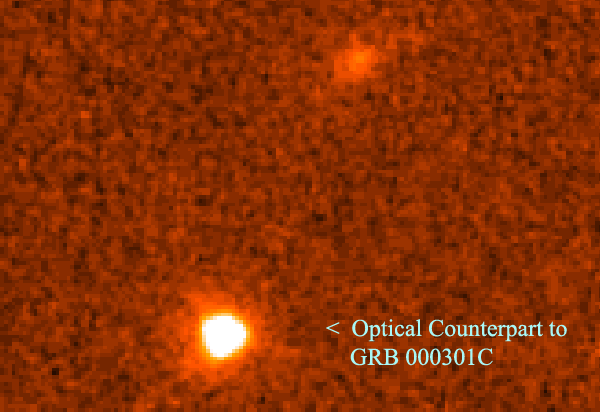
The history of astronomy is a history of coordination. When a transient event like a gamma-ray burst occurs, the response is a global symphony of instruments, each capturing a different frequency of the explosion's fading light. This multi-messenger approach is essential for distinguishing between a binary black hole system and a single, reddened active galactic nucleus. Without the ability to synthesize data from X-ray, infrared, and optical sources, the true nature of these high-energy events would remain obscured by the limitations of any single instrument.
Ultimately, the goal remains the reconstruction of the cosmic narrative. Whether analyzing the tidal tails of a galaxy merger or the spectral energy distribution of a distant quasar, the objective is to piece together how the universe arrived at its present state. Each observation, whether it confirms a model or introduces a new mystery, adds another layer to our understanding of a cosmos that is as dynamic as it is vast.