Nebulae: Cosmic Cycles of Stellar Life
Nebulae are the cosmic bookends of stellar life, marking both the violent birth of stars and the quiet, radiant exhaustion of their final acts.
The Catalog of Errors
In the eighteenth century, the French astronomer Charles Messier spent his nights scanning the heavens for comets. His work was a meticulous exercise in exclusion; he cataloged diffuse, stationary smudges that threatened to distract him from his primary quarry. Among these, the twenty-seventh entry in his list, M27, appeared as a modest, rounded shape in his telescope. He could not have known that he was observing the terminal phase of a sun-like star, a phenomenon we now call a planetary nebula. These objects are neither planets nor comets, but the luminous, shed skin of a star that has run out of nuclear fuel.
Messier was cataloging the ghosts of stars, unaware that he was documenting the inevitable future of our own sun.
An Inheritance of Gas
The Dumbbell Nebula, as M27 is colloquially known, serves as a preview of our own solar system's eventual fate. When a star of relatively low mass exhausts its core hydrogen, it undergoes a transformation, casting its outer layers into the surrounding vacuum. These layers are then illuminated by the intense, invisible ultraviolet radiation emanating from the exposed, cooling core—a white dwarf. The result is a symmetric, glowing shell of gas, rich in the signatures of sulfur, hydrogen, and oxygen, stretching across light-years of space.
Nurseries in the Dark
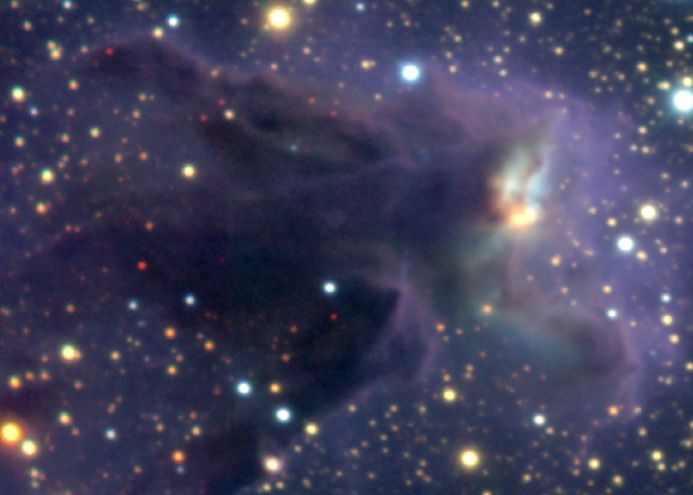
While planetary nebulae represent the end of a cycle, other regions of the sky are defined by the raw, chaotic energy of creation. The Eagle Nebula, or M16, is a stark contrast to the quiet dispersal of a dying star. Here, massive pillars of interstellar dust and gas act as nurseries. Within these towering structures, astronomers have identified finger-like projections known as evaporating gaseous globules, or EGGs. These are the cradles of newborn stars, shielded for a time within the dense, opaque core of the cloud.
The pillars of the Eagle Nebula are not permanent monuments, but temporary scaffolds being eroded by the very stars they helped bring into existence.
The Race Against Erosion
The life of a star within these nurseries is a race against erosion. As nearby hot stars ignite, their intense radiation begins to strip away the surrounding dust. This process is a double-edged sword: it reveals the stars forming within, but it also cuts them off from the reservoir of material necessary for their continued growth. If the cloud is eroded too quickly, the potential for these young stars to develop their own planetary systems may be permanently compromised.
The Complexity of the Void
Not all nebulae fit neatly into these two categories of birth and death. Some, like the Giant Squid Nebula, or Ou4, challenge our understanding of distance and scale. Discovered only in 2011, this bipolar structure appears to be a massive outflow of gas driven by a triple-star system. It is a reminder that the interstellar medium is a complex, layered environment where the energetic output of massive stars can carve out vast, unexpected shapes, such as the squid-like form nested within the larger, reddish hydrogen cloud of the Flying Bat Nebula.