Ghostly Clouds of the Milky Way
Nebulae serve as both the nurseries of new stars and the ornate shrouds left behind by those that have reached their end.
The Final Breath of Stars
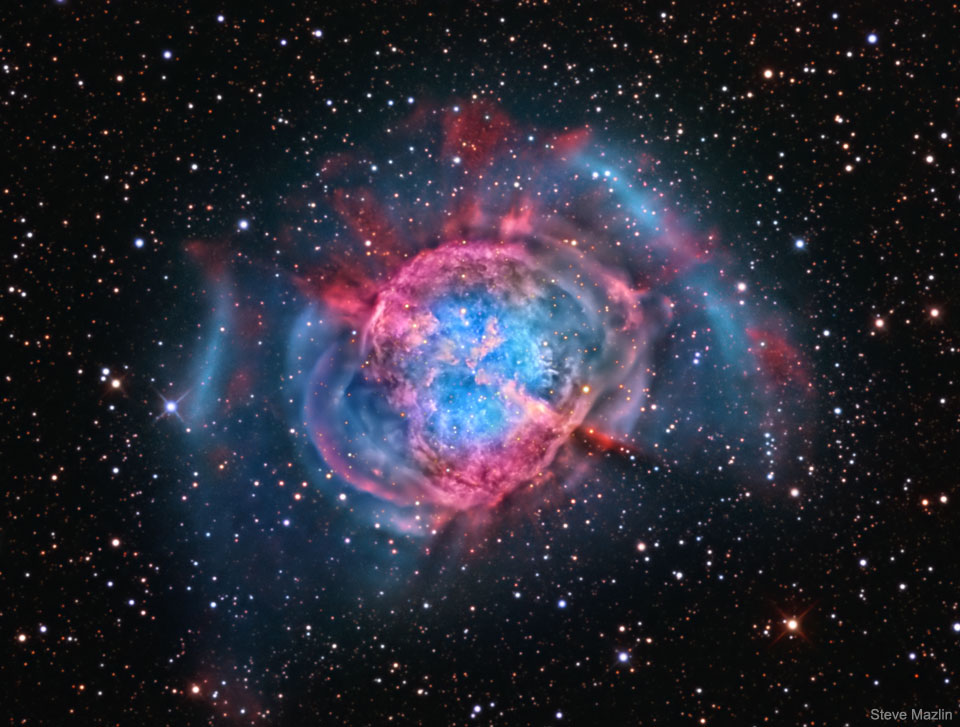
When a star of modest mass, much like our own Sun, exhausts its nuclear fuel, it does not vanish quietly. Instead, it sheds its outer layers, casting them into the void to form a planetary nebula. Despite the name, these structures have nothing to do with planets; they are the luminous, gaseous remains of a dying star. The Ring Nebula, or M57, provides a classic example of this phenomenon. From our vantage point on Earth, we look down the barrel of a roughly cylindrical cloud, creating the illusion of a perfect, glowing band. In reality, the structure is far more complex, with expansive, looping filaments extending well beyond the familiar central ring.
These nebulae are illuminated by the exposed, white-hot core of the former star. Intense ultraviolet radiation ionizes the surrounding gas, causing oxygen atoms to emit a ghostly greenish light and hydrogen to glow in deep reds. While M57 and the Dumbbell Nebula, M27, are among the most studied, the precise physical mechanism that drives a star to cast off its envelope so violently remains a subject of ongoing inquiry. These objects offer a preview of our own solar system's eventual fate, providing a glimpse of the transition from a stable star to a cooling white dwarf.
These nebulae are the luminous, gaseous remains of a dying star.
Nurseries in the Dark
Not all nebulae are marks of expiration. In the crowded starfields of the Sagittarius constellation, we find the Lagoon and Trifid nebulae, regions of intense stellar formation. These stellar nurseries are vast, with the Lagoon Nebula alone spanning over a hundred light-years. Within these clouds, the raw materials for new suns are gathered, shaped by gravity and the interplay of dust and gas.
The visual character of these regions is defined by the chemistry of the interstellar medium. The dominant red hues arise from hydrogen gas excited by the radiation of young, hot stars, while the blue tones, particularly prominent in the Trifid, are the result of starlight reflecting off fine dust particles. These regions are separated by dark, opaque lanes of dust, which obscure the activity occurring within, reminding us that the birth of stars is a process often hidden behind thick, impenetrable veils.
The Aftermath of Cataclysm
While planetary nebulae represent the slow, shedding of a star's skin, a supernova remnant like the Veil Nebula is the result of a sudden, violent death. When a massive star reaches the end of its life, it detonates in a cataclysmic explosion, sending a shock wave racing through the surrounding space. This wave plows through the interstellar medium, sweeping up and exciting material in its path.
The Veil Nebula, also known as the Cygnus Loop, is a sprawling testament to such an event. What we perceive as delicate, glowing filaments are, in three dimensions, long ripples in a sheet of gas seen nearly edge-on. These structures are remarkably well-defined, with atomic hydrogen and oxygen separated into distinct red and blue-green regions. Spanning nearly 70 light-years, the nebula serves as a lingering echo of an explosion that likely reached our skies over 5,000 years ago, a reminder that the stillness of the night sky is punctuated by the violent restructuring of the galaxy.
The Veil Nebula serves as a lingering echo of an explosion that occurred thousands of years ago.
Cataloging the Diffuse
The history of our understanding of these objects is tied to the patience of 18th-century observers like Charles Messier. Seeking to avoid confusion with comets, Messier compiled a list of diffuse, static objects that populated the night sky. He could not have known the true nature of the M27 or the M8 he recorded; the physics required to explain their light and structure remained centuries away. Today, we view these objects not as mere nuisances to comet hunters, but as the primary stages of stellar evolution.
Modern imaging has transformed our relationship with these clouds, allowing us to combine data from ground-based observatories with space-based telescopes. By mapping the specific light emitted by hydrogen and oxygen, we can peel back the layers of these nebulae to reveal the mechanics of their creation. Whether they are the cradles of future solar systems or the scattered remains of ancient explosions, these clouds define the cycle of matter in the Milky Way.