Oceanic Structures and Benthic Adaptation
From the microscopic colonies of the bryozoan to the colossal scale of the blue whale, the ocean remains a masterclass in adaptation and hidden complexity.
The Builders of the Benthos
The seafloor is rarely the barren expanse it appears to the casual observer. It is, instead, a crowded, competitive landscape populated by bryozoans—colonial animals that construct intricate, often lace-like structures upon rocks and shells. Species such as the narrow-leaved hornwrack, Securiflustra securifrons, exemplify this quiet industry. These organisms function as suspension feeders, extending ciliated tentacles to harvest passing phytoplankton. Their existence is one of constant, incremental expansion, achieved through the asexual budding of individual zooids into complex, branching fronds. This process allows them to colonize hard substrates from the nearshore shallows to depths of one hundred meters, enduring the cold temperate waters of the northern hemisphere.
The seafloor is a crowded, competitive landscape populated by colonial animals that construct intricate, lace-like structures upon rocks and shells.
Variations in the Colony
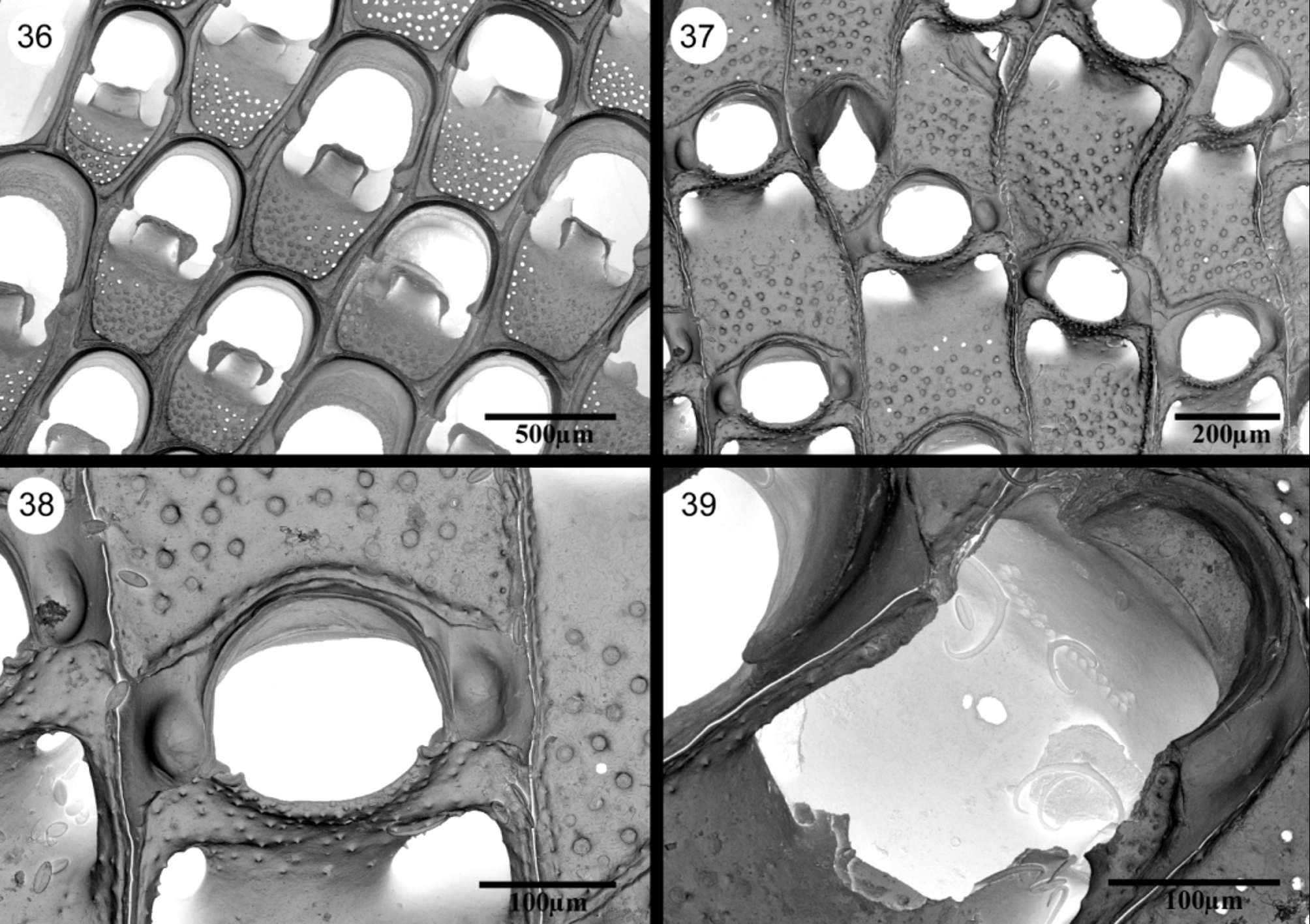
Taxonomic classification of these marine colonies often reveals the subtle, sometimes frustrating, inconsistencies of biological reality. Researchers examining Thalamoporella floridana in Brazil or Celleporaria pilaefera in the Indo-West Pacific frequently encounter specimens that defy established descriptions. In some populations of C. pilaefera, for instance, the expected spatulate avicularia—specialized, beak-like structures used for defense or cleaning—are entirely absent, while others show marked differences in their suboral projections. Such discrepancies remind us that a species is not a static blueprint but a fluid entity, shaped by local environmental pressures and genetic drift, often leaving scientists to debate whether a specimen is a true representative of its kind or a distinct, overlooked cousin.
The Jelly Web
Rising from the benthos into the water column, we encounter the gelatinous zooplankton, or Gelata. Long dismissed as mere trophic dead ends, these fragile, transparent organisms are now recognized as integral components of the marine food web. Far from being simple drifters, many gelatinous species function as sophisticated predators, with medusae and ctenophores exerting ecological influence comparable to that of larger fish. Their role as ecosystem engineers is equally significant; by grazing on phytoplankton and rapidly reproducing in dense blooms, they facilitate the biological carbon pump, transporting carbon-laden particles into the deep sea. When these blooms collapse, they can alter the chemistry of the water column, underscoring the profound impact these ephemeral creatures have on global nutrient cycling.
These fragile, transparent organisms are now recognized as integral components of the marine food web, exerting ecological influence comparable to that of larger fish.
Giants of the Abyss
The ocean’s capacity for extreme morphology is perhaps best illustrated by the giant squid, Architeuthis dux, and the blue whale, Balaenoptera musculus. While the former utilizes ammonium chloride to maintain neutral buoyancy in the abyssal dark, the latter represents the pinnacle of mammalian scale, a filter-feeder that has navigated the transition from the Miocene to the present. Both species occupy vastly different niches—one a deep-sea predator with eyes the size of dinner plates, the other a migratory titan of the open ocean—yet both are defined by their sheer physical presence. Their histories are written in the records of whalers, the logs of early twentieth-century expeditions, and the modern, precise data of genomic sequencing, which continues to reveal the hidden lineages and hybridizations that have shaped their survival.
The Limits of Control
As human interest in marine resources grows, the pressure to domesticate these wild systems increases. Research into the red alga Asparagopsis taxiformis, for example, highlights the tension between biological potential and commercial reality. While the alga shows promise in mitigating methane emissions from livestock, its cultivation requires precise environmental control—temperature, light, and carbon dioxide levels—that mimics its natural habitat. This effort to harness a single species for human benefit serves as a final, sobering reminder: the ocean is a complex, interconnected machine, and our attempts to manage it often reveal how little we truly understand about the delicate balance required to sustain its inhabitants.