Galaxies in Constant Motion
From the chemical signatures of ancient mergers to the turbulent influence of cluster weather, galaxies are defined by their constant, messy interactions with the universe around them.
The Anatomy of a Collision
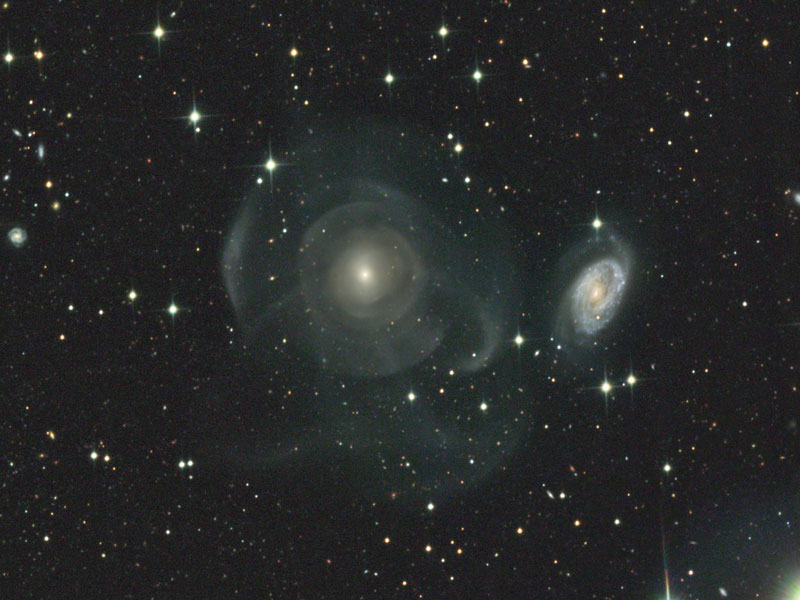
Galaxies are frequently imagined as static, island universes, yet they are better understood as restless, metabolizing systems. Far from being isolated, they are constantly shaped by the accretion of smaller neighbors, a process of galactic cannibalism that leaves behind visible scars. In the constellation Pisces, the galaxy NGC 474 displays a series of faint, concentric shells—ripples in a cosmic pond that likely record the absorption of smaller companions over the last billion years. Similar dynamics are visible in the blue arc of young stars trailing near Centaurus A, a stream of material torn from a dwarf galaxy as it was consumed. These features reveal that the outer halos of massive galaxies are rarely smooth; they are instead cluttered with the debris of past interactions.
Galaxies are better understood as restless, metabolizing systems.
Chemical Echoes of the Past
The history of our own Milky Way is written in such events. Detailed analysis of the Gaia-Sausage-Enceladus merger shows that this singular, violent encounter fundamentally altered our galaxy. By examining elemental abundances—specifically the ratios of magnesium, iron, barium, and europium—astronomers have reconstructed the star formation history of the progenitor galaxy. This intruder did not simply vanish; it left behind a distinct chemical signature that indicates star formation within it was quenched roughly when it fell into the Milky Way. This suggests that the growth of large galaxies is not a steady accumulation but a series of punctuated, transformative events.
The Internal Life of Discs
Even when galaxies appear undisturbed, their internal structures betray a history of movement and instability. Observations of edge-on disc galaxies reveal a surprising prevalence of kinematic sub-structures, such as boxy-peanut bulges and nuclear discs. These features are not merely decorative; they are the kinematic consequences of stellar bars and internal gas dynamics. In many cases, the observed motions of stars are entirely explained by these internal disc structures, removing the need to invoke the presence of dispersion-dominated bulges. The internal life of a galaxy is a continuous negotiation between its rotation and the gravitational instabilities that redistribute its mass.
Instability at the Edge of Time
At the furthest reaches of the observable universe, the story remains one of active, messy growth. Massive, dusty, star-forming galaxies at high redshifts appear to be bulge-less discs, yet they are far more unstable than their local counterparts. Their high gas content and lack of a stabilizing central bulge make them prone to fragmentation, whether triggered by secular processes or minor external perturbations. These systems are not necessarily the products of late-stage major mergers, as once assumed; rather, they represent a common disc-like structure that is simply more volatile due to its specific composition and evolutionary stage.
The internal life of a galaxy is a continuous negotiation between its rotation and the gravitational instabilities that redistribute its mass.
Weather in the Cluster
The environment surrounding a galaxy acts as a final arbiter of its morphology, particularly when it hosts powerful radio jets. Giant radio galaxies, which can span megaparsecs, often exhibit signs of recurrent activity and significant misalignment. These distortions are frequently the result of cluster weather—the complex, dense environments of galaxy clusters that exert pressure on the jets, causing them to bend or become asymmetrically contaminated. Whether through the slow accretion of dwarf satellites or the violent interaction of relativistic jets with the intergalactic medium, a galaxy’s final form is always a reflection of its surroundings.