Galactic Evolution Through Cosmic Migration
Galaxies are not static monuments but dynamic systems shaped by internal migration, ancient collisions, and the relentless pressure of their cosmic neighbors.
Anatomy of the Disc
Galaxies are frequently imagined as static, idealized pinwheels, yet a closer inspection of their vertical structure reveals a history of internal agitation. By observing edge-on galaxies, astronomers can peel back the layers of these systems, separating the light of various components to see how they behave. Recent surveys have shown that the vertical evolution of a disc is rarely uniform. Instead, it is governed by a variety of kinematic sub-structures, such as boxy-peanut bulges and nuclear discs, which act as markers for the galaxy's internal dynamics. These features suggest that what appears to be a simple, rotating disc is often a complex machine, shaped by the migration of stars and the projection of internal bars.
What appears to be a simple, rotating disc is often a complex machine, shaped by the migration of stars.
The Weight of Early Giants
The early Universe presents a paradox of scale. Observations of active galactic nuclei at high redshifts reveal black holes that are unexpectedly massive relative to their host galaxies. In some cases, these central engines approach the total stellar mass of their surroundings, a ratio that defies expectations derived from the local Universe. While these early black holes appear to be over-massive, they align more closely with local relationships involving velocity dispersion, hinting that these gravitational connections are fundamental constants of galactic growth. These systems, often found in metal-poor environments, may be the remnants of direct collapse scenarios, where massive seeds grew rapidly before their host galaxies could catch up.
Collisions and Cosmic Weather
Galaxies are not islands; they are participants in a constant, often violent, exchange with their environment. Large elliptical galaxies, such as NGC 474, display complex shells and ripples that function like rings in a pond, likely the result of absorbing smaller neighbors over the last billion years. This process of accretion is a defining feature of galactic life. Even the most dominant members of galaxy clusters, such as NGC 1275, are not immune to this turmoil. They feed on the debris of infalling galaxies, using magnetic fields to maintain the integrity of gas filaments that would otherwise be shredded by the surrounding chaos.
This environmental influence extends to the radio spectrum. Giant radio galaxies, which stretch across megaparsecs, reveal the impact of cluster weather. As these systems eject jets of material, the surrounding medium acts as a distorting force, inducing misalignments and asymmetries. These giant structures are not merely static monuments; they are records of recurrent activity, shaped by the dense, often hostile environments in which they reside.
Galaxies are not islands; they are participants in a constant, often violent, exchange with their environment.
Scars of the Milky Way
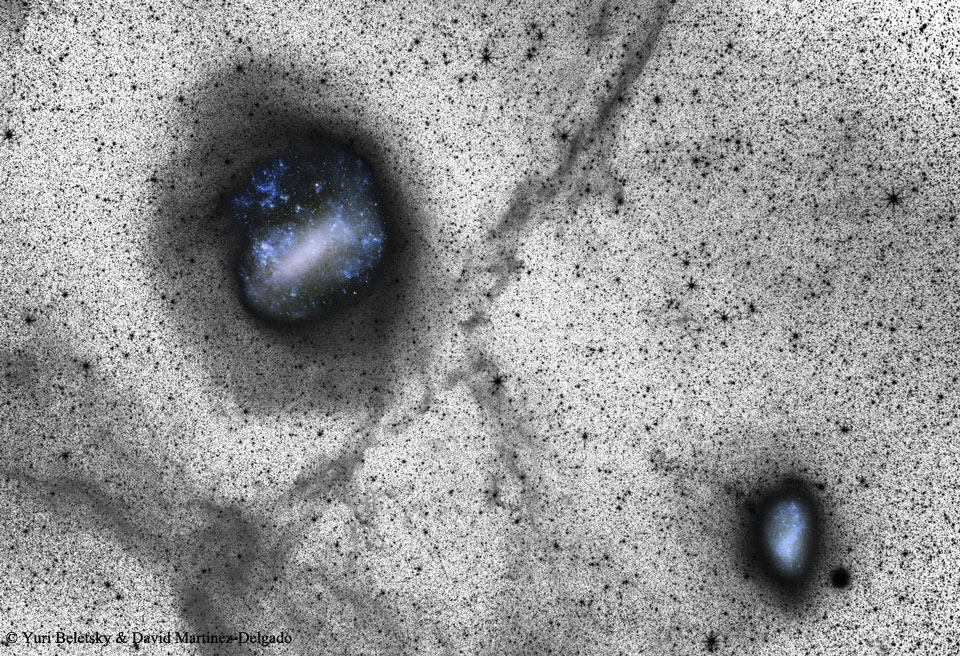
Our own galaxy is a palimpsest of past encounters. The Gaia-Sausage-Enceladus merger, a major event in the Milky Way's history, left behind a trail of stars whose elemental abundances serve as a chemical fossil record. By analyzing ratios of magnesium, iron, and europium, researchers have reconstructed the star formation history of this disrupted progenitor, noting that it quenched abruptly as it was consumed by our galaxy. Similar evidence of interaction is visible in the Magellanic Clouds, where faint stellar streams suggest a history of gravitational stripping and collision.
This theme of external triggering is mirrored in starburst galaxies like M82. A close encounter with a neighbor can ignite a furious, short-lived period of star formation, driving superwinds that eject enriched material into the intergalactic medium. These outflows, reaching tens of thousands of light-years, ensure that the consequences of a galactic collision are felt far beyond the galaxy's visible boundaries, scattering the heavy elements forged in its core into the void.