Galactic Evolution Through Collision and Flux
Galactic history is not a static record but a violent, ongoing process of accretion, collision, and internal structural reorganization.
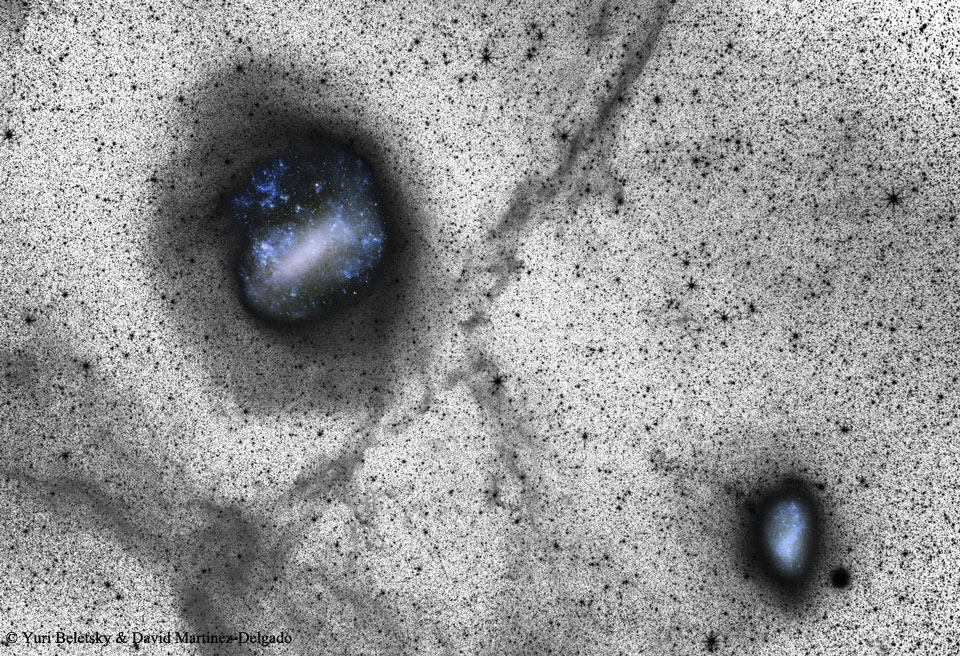
Collisions and the Architecture of Ripples
Galaxies are rarely the isolated, orderly islands they appear to be in shallow photographs. When two galaxies interact, the results are often less like a collision of solid objects and more like the passage of a stone through a pond. The Cartwheel Galaxy serves as the archetype for this phenomenon: a smaller intruder galaxy punched through a larger neighbor, sending a shockwave of compressed gas and dust rippling outward to trigger a massive burst of star formation in a ring over 100,000 light-years across. This is not a singular event but a recurring theme in cosmic evolution.
Even when the impact is less dramatic, the legacy of these encounters remains etched into the structure of the host. Elliptical galaxies such as NGC 474 display complex, layered shells that suggest a history of absorbing smaller neighbors. These features act as a record of tidal disruption, proving that the outer halos of large galaxies are far from smooth. They are instead dynamic environments shaped by the frequent accretion of smaller systems, a process that continues to influence the morphology of galaxies long after the initial encounter has concluded.
Galaxies are not static islands but dynamic systems shaped by the violent, recurring history of their own growth.
The Chemical Ledger of Disrupted Progenitors
The history of a galaxy is written in the elemental abundances of its stars. By examining the ratios of magnesium, iron, barium, and europium, astronomers can reconstruct the star formation history of long-disrupted satellites. The Gaia-Sausage-Enceladus merger, a pivotal event in the development of the Milky Way, left behind a population of stars whose chemical signatures reveal a gradual start to star formation, lasting over two billion years before being quenched by the merger itself.
This chemical record allows researchers to distinguish between different evolutionary paths. While some galaxies experience steady, prolonged star formation, others are forced into sudden, intense bursts. In the Cigar Galaxy, M82, a close encounter with M81 triggered a starburst so violent that it drives a superwind of enriched gas into intergalactic space. This outflow not only redistributes heavy elements forged in massive stars but also highlights how external gravitational triggers dictate the internal life cycles of galaxies.
Internal Mechanics and the Vertical Disc
Beyond the influence of external mergers, galaxies possess internal mechanisms that drive their vertical evolution. The GECKOS survey, which examines edge-on disc galaxies, reveals a surprising diversity in kinematic sub-structures. Rather than relying on dispersion-dominated bulges, many of these systems host boxy-peanut bulges—the projected signatures of stellar bars—and nuclear discs that dictate the motion of stars within the disc plane. These structures are not merely decorative; they are fundamental to how a galaxy distributes its mass and angular momentum.
Disentangling these components requires high-resolution spectroscopy, which remains the only reliable method for resolving the degeneracy between age, dust, and metallicity. As data from surveys like LEGA-C demonstrate, quiescent galaxies at high redshifts are typically older and less dusty than their star-forming counterparts. By pairing spectroscopy with photometry, astronomers can finally map the light-weighted ages and metallicities of these populations, moving past the limitations of older, less precise observational techniques.
Jet Stability and the Cluster Weather
At the centers of many galaxies, supermassive black holes launch relativistic jets that can span megaparsecs. These giant radio galaxies are not static emitters; they are subject to the volatile conditions of their environment. The study of double-double radio galaxies reveals that the cocoons in which these jets grow are frequently contaminated by surrounding material. This 'cluster weather' can induce significant misalignment in the jets, forcing them to deviate from their original axes as they interact with the dense, turbulent medium of a galaxy cluster.
Even when jets are not interacting with large-scale clusters, their internal evolution is governed by the pressure of the ambient medium. Simulations show that the transition between jet morphologies—such as the plume-like FR I class and the more structured FR II—depends on the balance between jet power and external pressure. Recollimation shocks, appearing as bright knots in radio maps, serve as visible markers of these pressure fluctuations. Whether through the formation of compact symmetric objects or the development of kink instabilities, the life cycle of a radio-loud active galactic nucleus is inextricably tied to the density and stratification of the space it traverses.
The Dark Matter Variable
The observed diversity of galaxy centers poses a persistent challenge to standard dark matter models. While conventional cold dark matter simulations struggle to explain the wide variation in central densities, the introduction of a subdominant component—such as ultralight dark matter—offers a potential resolution. If this component carries small-scale perturbations, it can seed early potential wells that eventually dominate the centers of small halos.
This central segregation provides a mechanism for the observed cusp-core diversity, suggesting that the dark matter composition itself may vary between galaxies. By allowing for stochastic variations in the central density, this model moves away from the assumption of a universal dark matter profile. It suggests that the smallest scales of the universe may hold the key to understanding the structural variety seen in the largest ones, provided we account for the complex, non-linear evolution of dark matter in the early stages of halo formation.