Galactic Evolution and Cosmic Instability
Far from being static monuments, galaxies are dynamic, evolving systems shaped by the relentless pressure of their neighbors and their own internal instability.
The Fluidity of Form
Galaxies are often depicted as static, majestic islands of light, yet they are more accurately understood as turbulent, evolving systems defined by their history of collisions and internal instability. The modern view of galactic life suggests that the smooth, featureless elliptical or the tidy spiral are merely temporary states. Instead, galaxies are constantly shaped by the accretion of smaller neighbors, the internal migration of gas, and the violent feedback of their own star-forming processes.
Galaxies are not static islands but turbulent systems defined by their history of collisions and internal instability.
Ripples in the Cosmic Pond
The life of a galaxy is frequently punctuated by the arrival of intruders. When a smaller galaxy passes through a larger one, the resulting gravitational disruption acts like a stone dropped into a pond. In the Cartwheel Galaxy, this interaction triggered a shockwave of star formation that rippled outward, creating a brilliant, ring-like structure. Similarly, the Tadpole Galaxy displays a long, sweeping tail of stars and gas, a tidal signature of a close encounter that will eventually dissipate as the debris settles into smaller satellite systems. These events are not rare anomalies but are fundamental to the growth of galactic halos, which are rarely smooth and instead carry the scarred evidence of past accretions.
The Internal Engine
Even without external interference, galaxies are prone to internal reorganization. Observations of edge-on, Milky Way-mass galaxies have revealed a surprising variety of kinematic sub-structures. Many of these systems host boxy-peanut bulges and nuclear discs, features that emerge from the complex movement of stars within a rotating disc. These internal structures are often the result of bars—elongated concentrations of stars—that redistribute mass and angular momentum. This internal evolution demonstrates that a galaxy does not need to be struck by an outsider to transform; the simple, long-term migration of its own stellar population is sufficient to rewrite its morphology.
A galaxy does not need to be struck by an outsider to transform; the simple, long-term migration of its own stellar population is sufficient to rewrite its morphology.
The Cost of Intensity
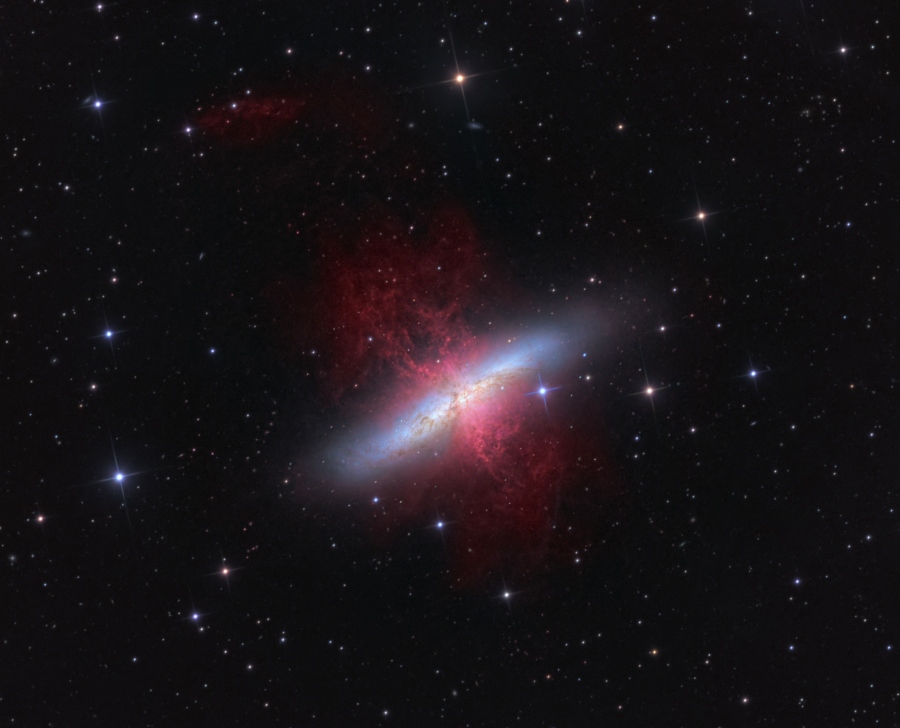
The most extreme transformations occur when star formation reaches a fever pitch. In galaxies like M82, the rapid birth of massive stars creates a superwind—a violent outflow of enriched gas and heavy elements that can extend tens of thousands of light-years into the halo. This process is a double-edged sword: while it drives the evolution of the galaxy by clearing out gas and distributing metals, it also marks a period of intense activity that cannot be sustained indefinitely. Eventually, such starbursts exhaust their fuel, leading to a quieter, more quiescent phase of existence.
Constraints of the Void
At the heart of these systems, supermassive black holes exert their own influence through relativistic jets. These jets, which can span millions of light-years, are sensitive to the environment through which they propagate. In dense cluster environments, the surrounding 'weather'—the pressure and distribution of intergalactic gas—can cause these jets to bend, twist, and misalign. The life cycle of these radio galaxies, characterized by recurrent bursts of activity, reveals that even the most powerful engines in the universe are ultimately constrained by the medium that surrounds them. Whether through the slow accumulation of dark matter or the sudden, violent impact of a passing neighbor, a galaxy’s final form is a record of its environment.