Collisions in the Cosmic Deep
Galaxies are not static islands but restless, interacting entities shaped by centuries of violent encounters.
The Anatomy of a Merger
Galaxies are frequently depicted as serene, isolated spirals, yet the reality is far more turbulent. Large galaxies are rarely pristine; they are often the result of long-term accretion, having spent eons consuming smaller neighbors. This process leaves behind visible scars, such as the complex shells surrounding the elliptical galaxy NGC 474, which likely represent tidal debris from past meals. Even our own Milky Way bears the marks of such history, most notably in the form of the Gaia-Sausage-Enceladus merger. By analyzing the elemental abundances of stars within this disrupted structure, researchers have reconstructed a history of gradual star formation that lasted over two billion years before being abruptly quenched upon the progenitor's absorption into our galaxy.
Galaxies are not static islands but restless, interacting entities shaped by centuries of violent encounters.
Ripples and Rings
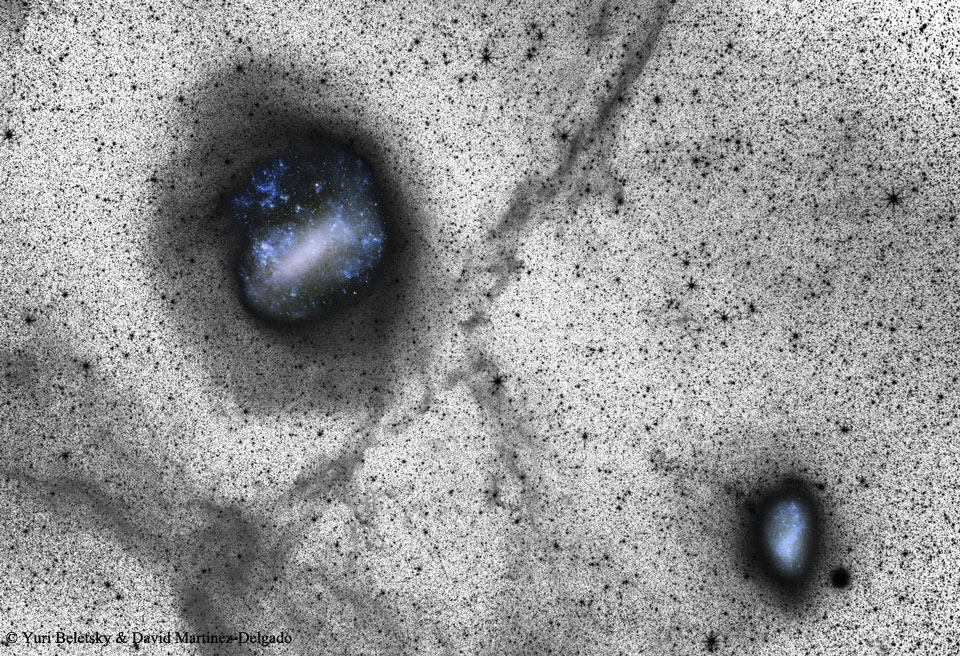
When galaxies collide, the stars themselves rarely touch, as the vast distances between them make direct impact improbable. Instead, the interaction is gravitational, a dance of distortion that can fundamentally reshape a galaxy’s appearance. The Cartwheel Galaxy serves as a perfect example of this phenomenon. A smaller intruder galaxy passed through the center of a larger one, sending a shockwave of compressed gas and dust rippling outward. This wave triggered a massive burst of star formation, creating the distinct, luminous ring that gives the galaxy its name. Similar, if less dramatic, processes are observed in the Magellanic Clouds, where faint stellar streams and asymmetric distributions suggest a history of gravitational tug-of-war between our own satellite galaxies.
The Engine of Starbursts
Interactions do more than rearrange stellar positions; they act as a catalyst for intense periods of star creation. In the Cigar Galaxy, M82, a close encounter with its neighbor M81 has ignited a furious starburst. This activity is so violent that it generates a superwind, a massive outflow of gas enriched with heavy elements that is being ejected into intergalactic space. At much greater distances—the epoch known as cosmic noon—dusty star-forming galaxies exhibit similar behaviors. Observations of these systems reveal asymmetric dust distributions and clumpy, disturbed morphologies, suggesting that minor mergers and flybys are the primary drivers of their prodigious star formation rates.
Interactions act as a catalyst for intense periods of star creation.
Internal Kinematics
Beyond the dramatic collisions, the internal structure of a galaxy provides a record of its evolution. By studying edge-on galaxies, astronomers can dissect these components with greater clarity. Recent surveys have identified common features such as boxy-peanut bulges, which are the projected signatures of stellar bars, and nuclear discs that influence the velocity dispersion of the galaxy’s core. These kinematic signatures allow researchers to map the history of a galaxy's disc without needing to assume the presence of dispersion-dominated bulges. Such tools, including sophisticated analysis pipelines, have moved the field toward a more nuanced understanding of how disc structure evolves over time.
The Early Giants
The earliest chapters of galactic history are currently being rewritten by the James Webb Space Telescope. Observations of the early universe have revealed active galactic nuclei that challenge our understanding of black hole growth. These early black holes are often over-massive relative to their host galaxies' stellar populations, suggesting that they may have formed from heavy seeds or undergone periods of super-Eddington accretion. While they appear to be outliers when compared to local mass relations, they align more closely with fundamental links between black hole mass and velocity dispersion. These findings suggest that the relationship between a galaxy and its central engine is a universal constant, established even in the chaotic, high-redshift environment of the infant universe.