Primordial Galaxies Observed by Webb
New observations from the James Webb Space Telescope are rewriting our understanding of how the first galaxies emerged from the primordial dark.
Shadows of the Beginning
For decades, the early universe remained a silhouette, glimpsed only through the faint, ancient glow of the cosmic microwave background. This relic radiation, mapped with precision by the Planck satellite, provided a foundational blueprint of a cosmos roughly 13.8 billion years old, yet it left the specific mechanics of galaxy formation largely to conjecture. We knew the universe transitioned from an opaque plasma to a transparent expanse, but the timing and nature of the first luminous structures were obscured by the limitations of our instruments. The Hubble Space Telescope’s deep-field surveys eventually pushed our gaze further, capturing light from galaxies as they existed when the universe was only a few percent of its current age, yet these images were snapshots of a process still largely in shadow.
The universe transitioned from an opaque plasma to a transparent expanse, but the nature of the first luminous structures remained obscured.
Accelerated Assembly
The arrival of the James Webb Space Telescope has shifted this perspective from static imagery to dynamic spectroscopy. By analyzing the light of galaxies at redshifts exceeding 10, researchers are now identifying objects that existed a mere 300 million years after the Big Bang. These early systems, such as the record-breaking JADES-GS-z14-0, appear as faint smudges in our field of view, yet they challenge existing models of how quickly matter could coalesce. The sheer abundance of bright galaxies discovered at these extreme distances suggests that our previous assumptions regarding the pace of early star formation were either too conservative or entirely incomplete.
The Engines of Reionization
To reconcile these observations, astrophysicists are refining their simulations to account for higher star-formation efficiencies and variations in the stellar initial mass function. Models incorporating radiation-hydrodynamics suggest that galaxies in the first billion years were not merely passive collections of gas but were active, efficient engines of production. Some theories posit that a top-heavy distribution of stellar masses—favoring more massive, luminous stars—could explain the unexpected brightness of these early systems. Furthermore, the role of low-mass galaxies appears critical; these smaller entities likely provided the bulk of the ionizing photons necessary to reionize the intergalactic medium, effectively clearing the fog of neutral hydrogen that once permeated the cosmos.
Early systems were not merely passive collections of gas but were active, efficient engines of production.
Gas and the Birth of Stars
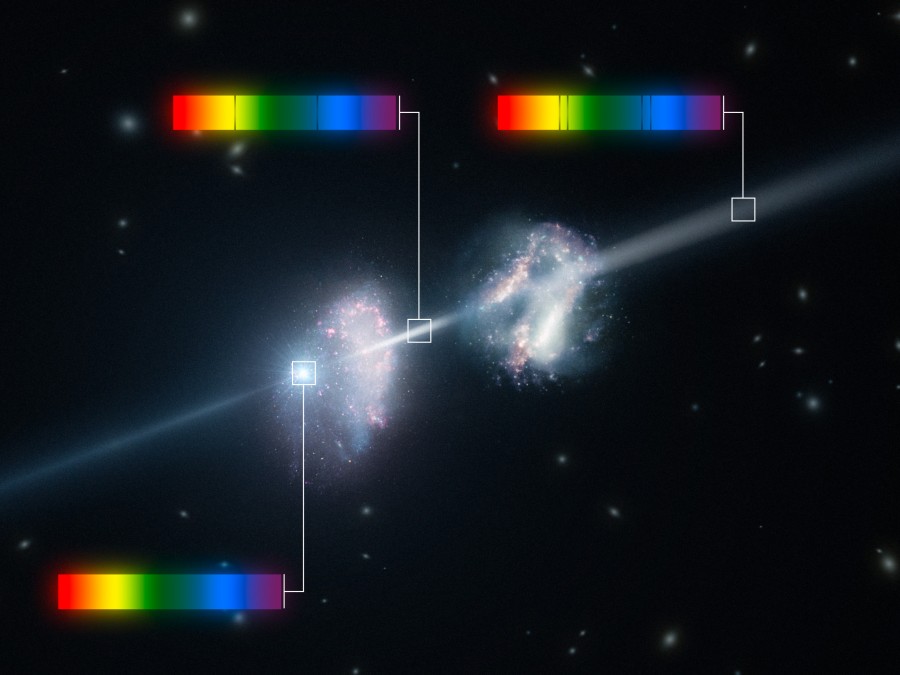
Spectroscopic surveys like the JWST-PRIMAL project have begun to map the physical state of the gas surrounding these nascent galaxies. By measuring the absorption signatures of neutral hydrogen, researchers have observed a transition in the environment of galaxies at redshifts between 6 and 13. At the earliest epochs, galaxies were often shrouded in dense, pristine gas, signifying a phase of rapid accretion. As these systems matured, the gas cooled and collapsed into stars, creating ionized bubbles that expanded outward. This process is not uniform; it is a complex interplay of gas inflow, starburst activity, and feedback mechanisms that regulate how galaxies grow and enrich their surroundings with heavy elements.
Feedback and the Mature Cosmos
Even in the relatively younger universe, the mechanisms of galaxy evolution were already violent and transformative. Observations of systems like J1316+2614 or the protocluster core GS5001 reveal that star formation can be so intense that it drives powerful outflows, expelling gas into the intergalactic medium. These outflows, coupled with the high star-formation efficiency, allow galaxies to shed dust and gas, effectively clearing their own paths for light to escape. Such extreme environments, where star formation rates reach levels typically seen in local globular clusters, serve as laboratories for understanding the feedback loops that define the lifecycle of a galaxy, from its first ignition to its eventual chemical maturation.