Cosmic Dawn Anomalies in Early Galaxy Formation
Recent observations from the James Webb Space Telescope have forced a radical reassessment of how the first galaxies and black holes emerged from the primordial dark.
An Unexpected Dawn
For years, the standard cosmological model presented a predictable, if gradual, narrative: the universe expanded, cooled, and eventually allowed gravity to pull matter into the first faint structures. The James Webb Space Telescope has disrupted this timeline. By peering into the first few hundred million years after the Big Bang, the telescope has revealed galaxies such as JADES-GS-z14-0, which existed when the universe was barely a fiftieth of its current age. These are not the tentative, wispy collections of gas one might expect, but surprisingly bright, mature-looking systems that challenge our understanding of how quickly the dark ages truly ended.
We are witnessing a cosmic assembly that appears to have bypassed the slow, steady growth predicted by our standard models.
Seeds of Massive Growth
The speed at which these early galaxies populated the void suggests that the mechanisms for star formation were far more efficient than previously modeled. Simulations now point to dense, young massive clusters as the primary engines of this era. In these extreme environments, runaway stellar collisions likely produced very massive stars that collapsed into black hole seeds within a few million years. This rapid-fire process provided the necessary gravitational anchors to pull in surrounding gas, allowing galaxies to reach significant luminosity and mass long before the universe reached its first billionth birthday.
The Black Hole Over-Mass Problem
Perhaps the most jarring discovery involves the central black holes of these early galaxies. Observations indicate that these objects are often over-massive relative to their host galaxies, sometimes approaching a one-to-one ratio with the total stellar mass. This contradicts the local relationship where black holes are mere fractions of their hosts. To reconcile this, researchers are exploring scenarios involving super-Eddington accretion, where black holes consume matter at rates far exceeding traditional limits. Some theorists have even proposed new geometric frameworks to explain how these black holes maintained stability while growing at such violent, unsustainable speeds.
Chemical Enrichment and Reionization
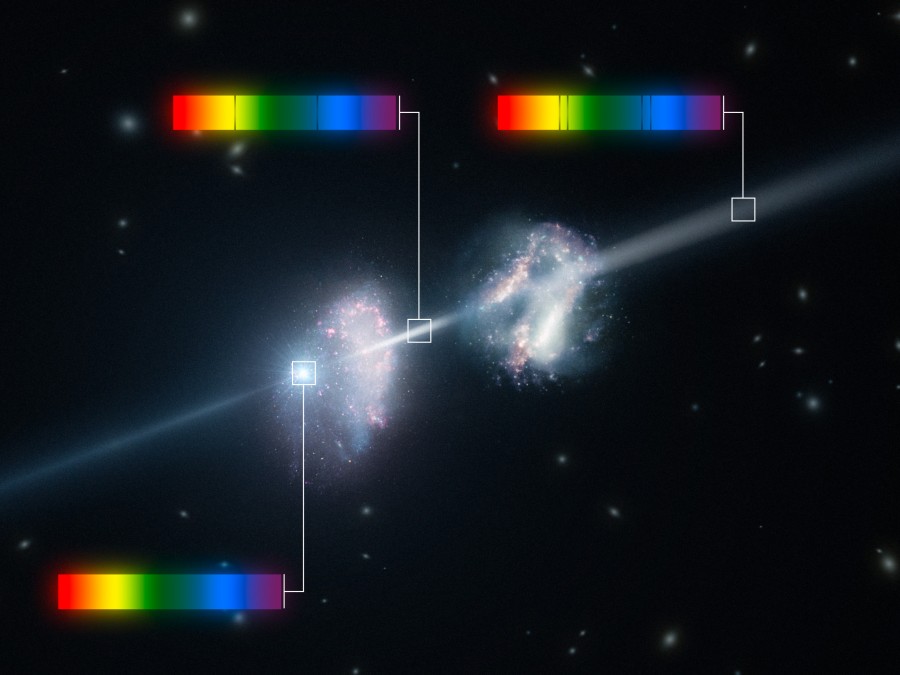
The early universe was not a pristine, uniform soup. Spectroscopy of distant galaxies and gamma-ray burst afterglows reveals that heavy elements were being forged and dispersed with remarkable speed. This chemical enrichment is a signature of the first generations of stars, which lived fast and died young, seeding the cosmos with the metals required for later stellar life. These same low-mass galaxies were the primary drivers of reionization, the process by which the first light stripped electrons from the surrounding hydrogen gas, finally rendering the universe transparent.
The universe did not merely turn on; it ignited with a chemical and structural complexity that we are only beginning to inventory.
Tension in the Data
These findings arrive at a moment of broader cosmological uncertainty. The discrepancy between the expansion rate measured from the early universe—via the cosmic microwave background—and the rate observed in the local universe remains a central point of contention. As physicists refine their models, incorporating new lattice methods and scalar-tensor theories, the goal is to create a unified framework that accounts for both the early-universe anomalies and the late-universe expansion. The data from the first billion years is no longer just a footnote in history; it is the primary laboratory for testing the limits of our current physical laws.