Cosmic Dawn and the Formation of Galaxies
New observations of the first galaxies are forcing a revision of how the universe transitioned from a dark, uniform expanse into a vibrant, structured cosmos.
A Glimpse of the Beginning
The universe is roughly 13.8 billion years old, a figure derived from the faint, pervasive heat left over from its infancy. This cosmic microwave background acts as a snapshot of a time when the universe first became transparent to light. Beyond this ancient surface, we look into the dark ages, a period of profound stillness before the emergence of the first stars. Recent observations have pushed our vision into this primordial era, revealing galaxies that existed when the universe was only a few percent of its current age. Among these, the galaxy JADES-GS-z14-0 stands as a record-holder, appearing as a faint smudge of light from a time just 300 million years after the Big Bang.
We are looking back toward the inaugural moment of the universe, searching for the first flickers of light in a long, cold silence.
Gas, Gravity, and Assembly
The formation of these early galaxies was not a gentle process. Spectroscopic surveys indicate that galaxies at high redshifts were often dominated by the accretion of pristine hydrogen gas. This material, falling into the gravitational wells of nascent structures, fueled intense bursts of star formation. In some cases, these starbursts were so violent that they cleared out surrounding gas and dust, allowing ionizing radiation to escape into the intergalactic medium. This feedback loop, where the birth of stars simultaneously shapes the environment and regulates further growth, is a defining feature of the early assembly phase.
The Chemical Inheritance
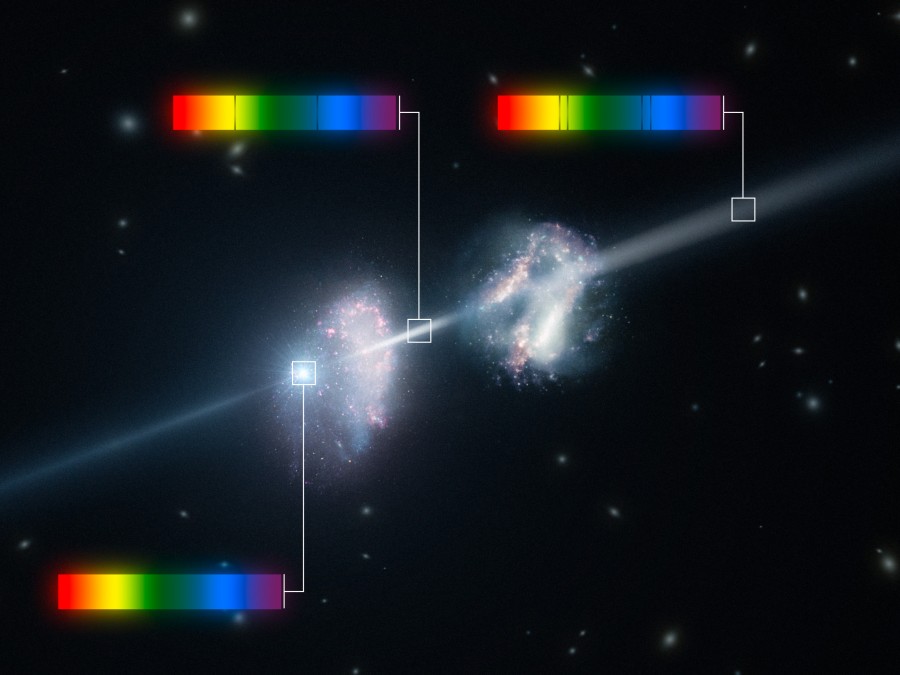
The speed at which these early galaxies enriched themselves with heavy elements remains a point of intense study. While one might expect the youngest systems to be chemically primitive, observations of distant galaxies—some caught in the afterglow of gamma-ray bursts—reveal surprisingly high abundances of metals. This suggests that the first generations of stars lived and died with remarkable haste, seeding their surroundings with the building blocks of future planets and life long before the universe had reached its current maturity. Models now suggest that star formation efficiencies were likely higher in the early universe to account for this rapid chemical evolution.
The youngest galaxies in the record were already busy forging the heavy elements that would eventually constitute the architecture of our own world.
Theoretical Frontiers
Understanding the physics of this era requires more than just observation; it demands a rigorous re-examination of gravity and inflation. Researchers are currently testing how scalar-tensor theories and lattice methods might explain the primordial curvature of space. These theoretical frameworks attempt to bridge the gap between the subtle fluctuations seen in the cosmic microwave background and the complex structures that emerged later. This work is often led by physicists who balance the abstract demands of cosmology with the practical, often difficult, realities of academic life, ensuring that the pursuit of knowledge remains as scrutinized as the theories themselves.