Mapping the Unseen Expansion
As our instruments reach deeper into the past, the standard model of the universe is being tested by new data and the persistent mystery of dark energy.
The Shifting Horizon
The history of the universe is written in the light we catch from its furthest reaches. For decades, our understanding of this expanse relied on the assumption that gravity behaves exactly as Einstein predicted. Yet, as our instruments have sharpened—from the early microwave radiometers built at Princeton to the sophisticated spectroscopic arrays of the Dark Energy Spectroscopic Instrument—the data have begun to suggest that our standard model is incomplete. We are no longer merely observing a static stage; we are attempting to map the shifting dynamics of a universe that appears to be accelerating in ways that defy simple explanation.
We are no longer merely observing a static stage; we are attempting to map the shifting dynamics of a universe that appears to be accelerating.
Beyond the Constant
At the heart of this inquiry is the nature of dark energy, a repulsive force that dominates the cosmic expansion. While early models treated this as a constant, recent analyses using weighted function regression suggest a more complex reality. Data from supernova catalogs and the cosmic microwave background point toward a transition in the behavior of dark energy, moving from a phantom-like state to quintessence at a redshift of approximately 0.4. This is not a settled matter, but the evidence for a non-monotonic evolution of dark energy density is becoming difficult to ignore, forcing researchers to move beyond the arbitrary truncations of older mathematical models.
The Scaffolding of Stars
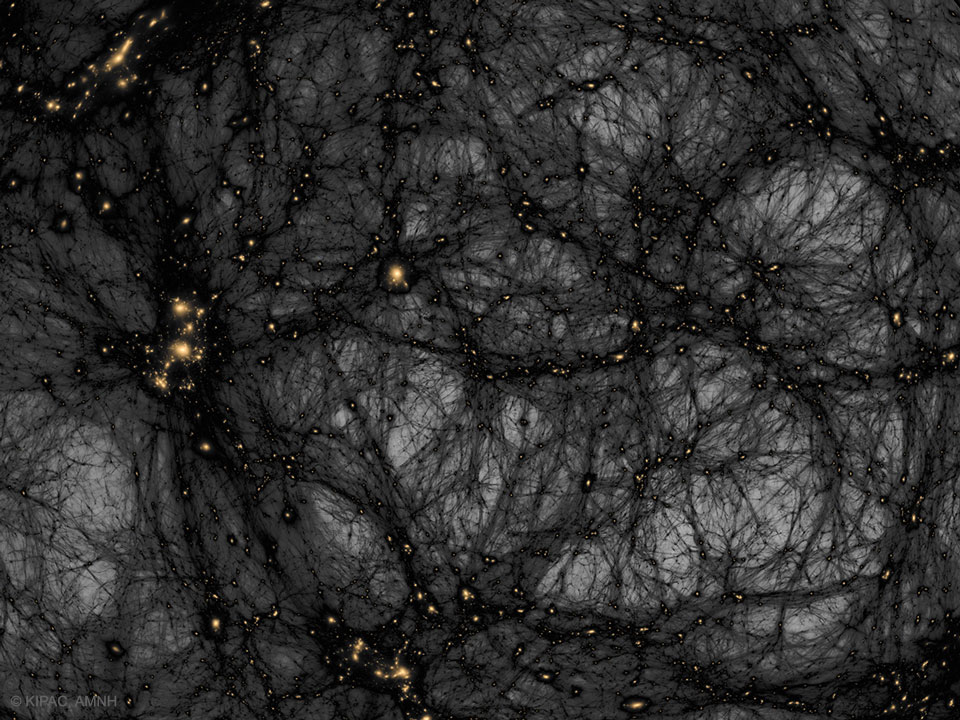
While dark energy dictates the expansion, dark matter provides the scaffolding. Simulations of the early universe reveal a web of filaments where baryonic matter clumps together, forming the first stars and eventually the galaxies we see today. These structures are not random; they are regulated by a delicate balance of gas accretion, star formation, and the feedback loops of supernovae. Observations from the James Webb Space Telescope have allowed us to test these models against the mass-metallicity relation of galaxies, revealing that the chemical enrichment of the cosmos is intimately tied to the stochastic nature of star formation.
The chemical enrichment of the cosmos is intimately tied to the stochastic nature of star formation.
The Observer's Dilemma
As we refine our maps of the void and the filament, we are also forced to confront the role of the observer. In a universe that may be infinite or populated by countless potential histories, the question of how we weigh our own existence becomes paramount. Modern cosmology is grappling with the measure problem: how to define the typicality of an observer without falling into the trap of assuming a global sampler. This is not just a philosophical exercise but a necessary step in grounding our statistical claims. Before we can speak of the probability of our own location in the cosmic timeline, we must first define the rules by which we count the observers themselves.
Reconciling the Local and the Universal
The universe remains a place of vast, empty voids and distant, colliding galaxies like Andromeda, which serves as a reminder of our own local movement within this grander architecture. Whether we are looking at the distribution of intergalactic helium or the cold spots in the cosmic microwave background, the goal remains the same: to reconcile the local with the universal. As we continue to test the limits of general relativity and explore alternative theories of gravity, we are slowly stripping away the assumptions that have long held our understanding of the cosmos in place.