Cosmic Refinement Through Galactic Mapping
From the first realization of distant galaxies to the precise mapping of dark matter and early-universe geometry, our understanding of the cosmos is a constant process of refinement and correction.
Beyond the Milky Way
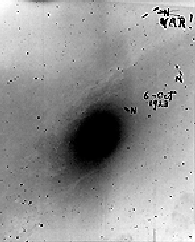
In 1923, Edwin Hubble peered at a photographic plate of the Andromeda Nebula and made a correction that fundamentally altered our sense of scale. He had initially marked a point as a nova, but upon closer inspection, he realized it was a Cepheid variable—a star whose rhythmic pulsations serve as a cosmic yardstick. By crossing out his initial label and writing "Var!", Hubble confirmed that Andromeda was not a mere cloud of gas within the Milky Way, but a vast, distant galaxy. This shift in perspective, moving from a static, singular system to an expansive universe of galaxies, remains the bedrock of modern cosmology.
The universe is not a singular, static stage, but a dynamic, expanding expanse measured by the flicker of distant stars.
Echoes of the Beginning
Decades later, the focus shifted from identifying individual galaxies to mapping the faint, uniform glow left over from the early universe. In the 1960s, researchers at Princeton University developed sophisticated radiometers, building on designs by Robert Dicke, to hunt for the remnant radiation of the Big Bang. While the discovery of the cosmic microwave background was famously preempted by Penzias and Wilson, these early instruments established the methodology for measuring the universe's thermal history. Today, that legacy continues with high-precision instruments like the Atacama Cosmology Telescope, which refine our understanding of the standard cosmological model, ΛCDM, by testing the fundamental assumptions of primordial perturbations and neutrino properties.
The Dark Sector Unmasked
As our observational tools have sharpened, so too has our ability to probe the dark sector—the mysterious components that dictate the expansion and structure of the cosmos. Recent data-driven frameworks now allow researchers to reconstruct the dark energy equation of state and potential dark-sector interactions without relying on rigid, pre-defined models. By analyzing supernovae and baryon acoustic oscillations, these methods test whether the dark sector is truly constant or if it hides more complex, evolving dynamics. Simultaneously, the study of gravitational waves offers a new window into the small-scale structure of the universe, potentially revealing the presence of elusive dark matter halos through the subtle, stochastic diffraction of waveforms.
We are moving toward a model-independent view of the dark sector, where the data itself dictates the history of expansion and growth.
Geometry in Flux
The early universe was not merely a smooth, isotropic expansion; it possessed an inherent richness in its geometry. Recent theoretical work has extended the separate-universe picture to include anisotropic spacetimes, where the mixing of scalar, vector, and tensor perturbations creates a more complex evolutionary path. By deriving conserved quantities that account for background shear and gauge-field tilts, physicists can now better predict the statistical anisotropies in primordial perturbations. This framework allows for a more nuanced understanding of how curvature perturbations couple with gravitational waves, providing a clearer view of the conditions that existed at the moment of horizon crossing.
The Assembly of the Cosmos
The assembly of galaxies across cosmic time reveals a story of rapid, efficient growth that occasionally defies traditional models. Observations from surveys like COSMOS-Web show that massive galaxies formed earlier than expected, suggesting that star formation efficiencies were significantly higher in the first billion years of the universe. While the emergence of quiescent galaxies at later epochs aligns with our understanding of growth suppression, the tension between early-universe predictions and current star formation measures remains a subject of intense study. As we refine our standard candles, such as Type Ia supernovae, we must also account for environmental biases, ensuring that our measurements of the universe's expansion are not skewed by the local conditions of the host galaxies.