Cosmic Expansion Dynamics and Universal Evolution
Recent observations and theoretical refinements suggest that the universe’s expansion is not merely a constant drift, but a complex, evolving narrative.
Testing the Limits of Relativity
For decades, the standard model of cosmology has relied on the assumption that gravity behaves according to the elegant, rigid prescriptions of general relativity. Yet, as our instruments grow more sensitive, the edges of this framework have begun to fray. Recent data from the Dark Energy Spectroscopic Instrument, combined with observations of the cosmic microwave background and supernova catalogs, have pushed researchers to test whether gravity might deviate from its predicted path. These studies examine parameters that quantify potential modifications to gravity, looking for signs that the force governing the cosmos might be more flexible than Einstein originally envisioned.
The universe does not simply sit still; it is a dynamic system whose governing rules appear to change as we look closer.
The Evolution of Repulsion
The mystery of dark energy—the repulsive force driving the accelerating expansion of the universe—remains the most significant challenge to our current understanding. While older models often treated dark energy as a static constant, newer analytical methods, such as weighted function regression, are revealing a more nuanced picture. By moving away from rigid, predetermined models, researchers have found evidence suggesting that dark energy may evolve over time. Data now points toward a transition in behavior at a redshift of approximately 0.4, where the energy density shifts in ways that a simple, unchanging constant cannot explain.
The Skeleton of the Cosmos
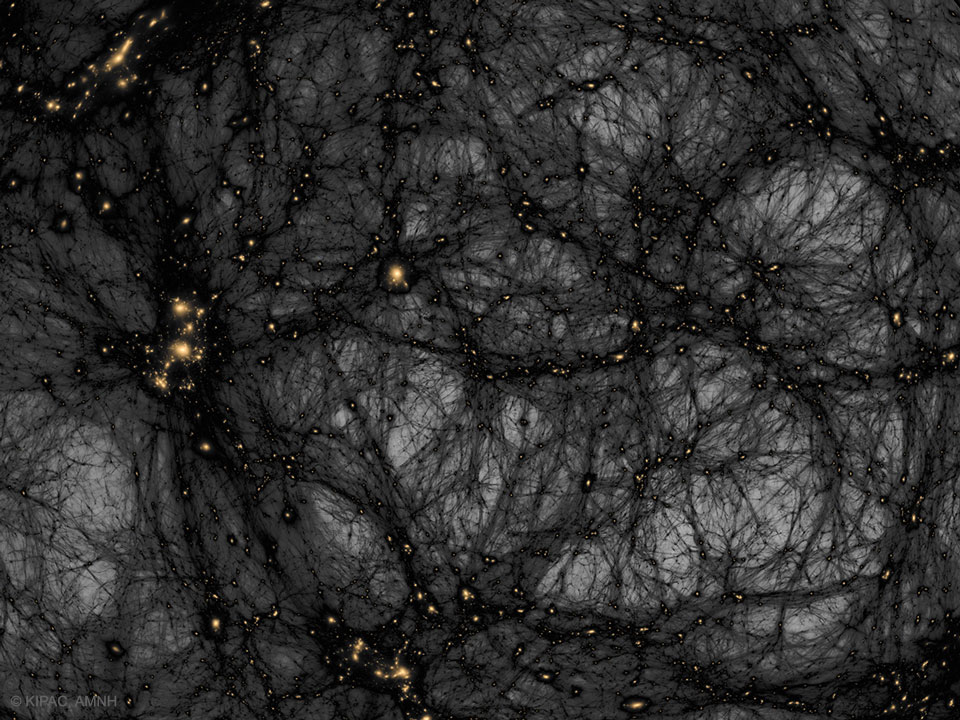
The cosmic web is not merely a collection of isolated galaxies, but a vast, interconnected structure of dark matter filaments and hot gas. Simulations have long suggested that the majority of the universe’s normal matter resides in these intergalactic filaments, a hypothesis confirmed by observations of X-ray absorption in distant quasars. These structures mirror the distribution of dark matter, forming a skeleton upon which the visible universe is draped. Observations from instruments like the Hopkins Ultraviolet Telescope have provided clear evidence of this distribution, showing how primordial matter organized itself into the bubble and void geometry that defines the large-scale structure of space today.
The Observer's Dilemma
As we refine our measurements of the early universe, we encounter the persistent problem of self-location. When we calculate the probability of observing specific cosmic phenomena, we must account for the fact that we are observers situated within a specific history. This requires a rigorous distinction between the physical laws governing the universe and the subjective criteria we use to weigh our own observations. The challenge lies in creating a framework that can handle the infinite possibilities of a vast universe without collapsing into paradoxes regarding typicality or the nature of the observer.
We are not merely observing the universe; we are attempting to define the very vantage point from which that observation occurs.
Instruments of the Ancient Sky
The history of cosmology is a history of tools. From the early Dicke radiometers designed to capture the faint, cooling echo of the Big Bang to the sophisticated satellite arrays that map the temperature fluctuations of the ancient sky, our progress has been defined by our ability to detect the invisible. Whether we are looking at the Andromeda galaxy—a neighbor whose light has traveled for millions of years—or probing the fundamental constants for signs of variation, each measurement serves to constrain the domain of our theories. As we continue to refine these constraints, we move closer to understanding whether the laws of physics are truly universal or if they, too, have a history of their own.