Cosmic Expansion and Persistent Unknowns
Modern cosmology grapples with a universe that refuses to simplify, as precision measurements reveal both the robustness of our standard model and the persistent shadows of the unknown.
A Century of Scaling Up
In the 1920s, Edwin Hubble transformed our understanding of the cosmos by identifying a single pulsating star in the Andromeda Nebula. By applying Henrietta Leavitt’s work on Cepheid variables, Hubble proved that Andromeda was not a mere cloud of gas within our own galaxy, but a distinct, massive system existing at a vast distance. This realization shattered the notion of a small, static universe, replacing it with the modern vision of a vast expanse populated by countless galaxies. Today, we continue to measure this scale, though the tools have shifted from photographic plates to the sophisticated satellite arrays and spectroscopic instruments that map the cosmic microwave background.
Hubble’s discovery is responsible for our modern concept of a Universe filled with galaxies.
The Persistence of the Standard Model
The current standard model of cosmology, known as Lambda-CDM, remains remarkably resilient despite rigorous testing. Recent data from the Atacama Cosmology Telescope and the Dark Energy Spectroscopic Instrument have scrutinized the foundational assumptions of this framework. Measurements of neutrino properties, the fine-structure constant, and the early-universe expansion history show no statistically significant departure from the baseline predictions. Even as researchers explore extensions—such as early dark energy or modified gravity—the data consistently pull the results back toward the established model, suggesting that our current description of the universe’s composition and evolution is a robust approximation of reality.
Darkness in the Details
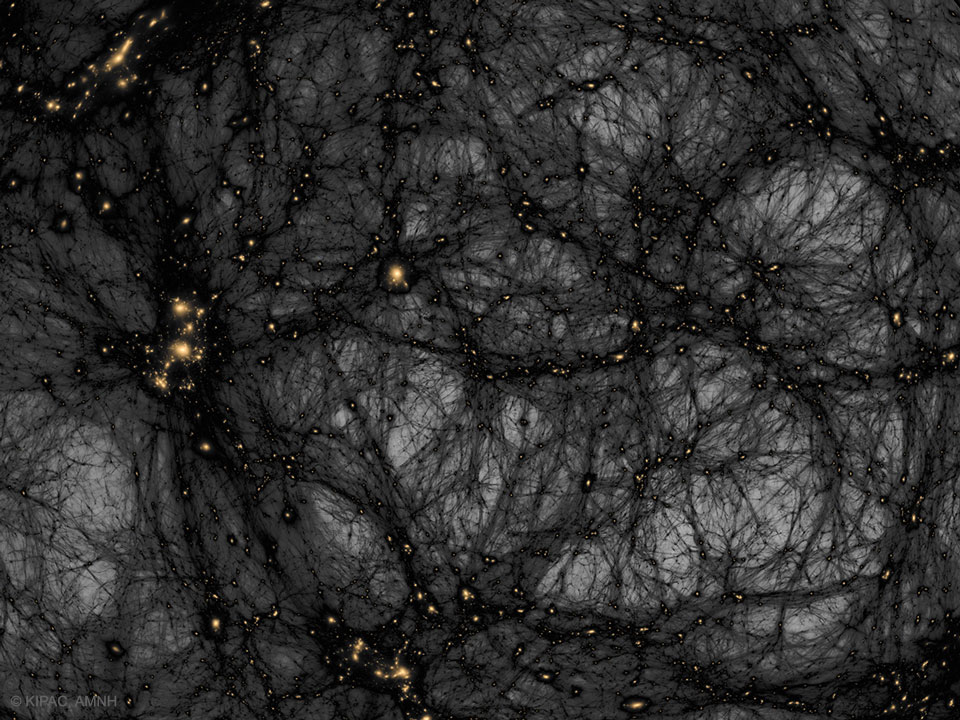
While the standard model holds, the dark sector remains a profound mystery. Dark matter, which acts as the gravitational scaffolding for galaxies, is often visualized as a complex web of filaments, a structure mirrored by the distribution of hot baryonic gas detected by X-ray observatories. Yet, dark energy—the force driving the accelerated expansion of the universe—presents a more elusive challenge. Recent attempts to break the degeneracy between dark energy dynamics and potential interactions within the dark sector have yielded no evidence for non-standard physics, leaving us with a universe dominated by components we can measure but not identify.
Dark matter, although quite strange and in an unknown form, is no longer thought to be the strangest source of gravity in the universe.
The Limits of Parametrization
The search for new physics is often hindered by the way we frame our questions. Traditional methods often rely on fixed parametrizations of dark energy, which can inadvertently bake assumptions into the results and create artifacts that look like physical discoveries. New, model-agnostic approaches, such as weighted function regression, allow the data to dictate the shape of the expansion history without forcing it into a pre-determined mold. These methods have confirmed that while hints of dynamical dark energy appear in some datasets, they remain sensitive to the choice of observational inputs and do not yet resolve the persistent tension between early-universe and late-universe measurements of the Hubble constant.
The Observer and the Measure
As we refine our maps of the cosmos, we also face the conceptual challenge of our own place within it. The measure problem asks how we should weigh the probability of our own existence in a universe that may be infinite or governed by complex, multi-layered histories. This is not merely a question of data, but of logic: we must distinguish between dynamical transition probabilities and the subjective credence of an observer located within a specific, decoherent history. Before we can claim to understand the typicality of our own observations, we must first define the formal bridge between the physical reality of the universe and the information updates that constitute our experience.