Cosmic Constants in Perpetual Flux
Modern cosmology is shifting from a settled narrative of static laws to a restless inquiry into whether the fundamental rules of the universe are as constant as we once assumed.
The Shifting Vacuum
For decades, the standard model of cosmology rested on a foundation of general relativity and a predictable, steady expansion. Yet, the modern observer finds this foundation increasingly porous. Recent data from the Dark Energy Spectroscopic Instrument, when synthesized with cosmic microwave background measurements and supernova catalogs, has begun to suggest that the dark energy driving our universe’s expansion may not be the static constant we once imagined. Instead, evidence points toward a dynamical evolution, where the nature of this repulsive force shifts over time, potentially transitioning between different physical regimes as the universe ages.
The universe is no longer a clockwork mechanism, but a system whose governing parameters may be in flux.
Gravity Under Revision
This search for dynamical behavior has forced theorists to reconsider the very geometry of gravity. By moving beyond the standard Einsteinian framework, researchers are exploring modified gravity theories—such as those involving non-metricity or complex scalar fields—to see if they can better account for the observed clustering of galaxies and the peculiar expansion history of the cosmos. These models often involve effective field theories that allow for phantom-crossing, a state where the dark energy equation of state crosses the threshold of negative pressure. Such theories must pass rigorous stability tests to ensure they do not produce ghost instabilities or gradient failures that would render the universe physically incoherent.
The Fragility of Constants
The ambition to refine these laws extends to the fundamental constants themselves. If the physical parameters that define our interactions—such as the strength of gravity or the mass of particles—were to vary across space or time, it would signal a profound violation of the weak equivalence principle. Testing the stability of these constants through atomic clocks, quasar spectra, and stellar physics provides an independent window into the dark sector. If a constant is not constant, it implies the existence of a dynamical field, effectively turning the background of the universe into an active participant in physical law rather than a passive stage.
Voids and Filaments
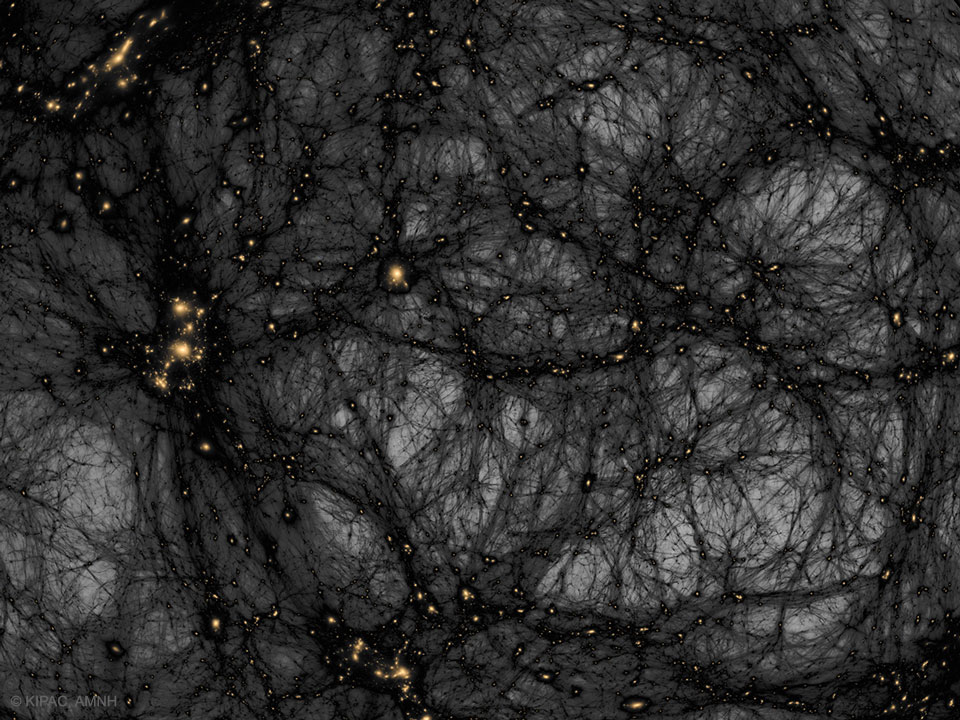
As we map the large-scale structure of the universe, we find a cosmic web of filaments where normal matter is dwarfed by the pervasive, invisible influence of dark matter. Simulations show this matter distributed in complex, web-like patterns, punctuated by vast voids—regions of space that appear almost entirely empty of matter, yet remain subject to the overarching influence of dark energy. These voids, some spanning billions of light-years, serve as laboratories for testing how gravity behaves over the largest possible scales, challenging our ability to distinguish between a truly empty region and one where light has been stretched by the expansion of space itself.
The Observer's Dilemma
Ultimately, the challenge of cosmology is as much epistemic as it is observational. When we ask questions about the universe, we are forced to confront the role of the observer. Recent inquiries into the measure problem highlight the difficulty of defining probability in an infinite or complex universe. We must distinguish between the statistical typicality of an observer and the subjective self-location of an individual within a history of information updates. As we refine our instruments—from the early Dicke radiometers that first sought the remnant heat of the Big Bang to the sophisticated spectroscopic arrays of today—we are not just measuring the universe; we are defining the limits of what an observer can meaningfully claim to know about a reality that may be far more fluid than our initial models allowed.