Computational Modeling Across Universal Scales
Across scales from the atomic nucleus to the cosmic web, computational modeling has become the primary lens through which we observe the otherwise invisible.
The Precision of the Proxy
When physical systems become too small, too dense, or too fleeting to measure directly, the model becomes the laboratory. In the study of neutron-rich exotic nuclei, researchers now augment theoretical frameworks with machine learning, specifically kernel ridge regression, to correct for the subtle deviations between calculated mass and experimental reality. This hybrid approach allows scientists to account for odd-even effects that previously eluded standard relativistic models, narrowing the margin of error to a few hundred kiloelectronvolts. Similarly, in the high-pressure, high-temperature environment of warm dense matter, researchers use x-ray absorption spectroscopy to test competing models, finding that density functional theory often outperforms traditional collisional-radiative approaches in capturing the complex electronic structure of compressed copper.
This drive for accuracy extends to the geological scale, where ab initio molecular dynamics simulations allow geochemists to calculate how isotopes fractionate during the partial melting of the mantle. By modeling the behavior of minerals like clinopyroxene under extreme pressures, researchers can determine whether the isotopic signatures found in natural basalts are the result of simple melting or more intricate, multi-stage petrogenesis. In each case, the model does not merely describe the system; it acts as a filter, separating the signal of fundamental physical laws from the noise of incomplete data.
The digital proxy must be refined until it yields not just a plausible image, but a reliable prediction.
Complexity and the Cost of Calculation
Computational cost is the silent arbiter of scientific progress. In the study of exoplanet atmospheres, the full chemical schemes required to track every potential reaction are often too heavy for the three-dimensional models needed to interpret data from next-generation telescopes. By reducing these schemes—stripping away non-essential reactions while maintaining the integrity of observable species like water and methane—researchers have achieved thirty-fold increases in processing speed. This efficiency allows for broader exploration of parameter spaces, from brown dwarfs to the tropospheres of our own solar system's gas giants.
A similar pragmatism governs the study of neutron stars. When analyzing thermonuclear X-ray bursts, the sheer multidimensionality of the parameter space often outstrips available computing power. By shifting from exhaustive training modes to ensemble analysis, researchers can now utilize consistent, clocked bursts to constrain the properties of host stars more efficiently. While these models still struggle to perfectly align with all observed data—particularly regarding fuel composition and system distance—they provide a necessary framework for interpreting the brief, violent flashes of light that serve as our only window into the physics of ultra-dense matter.
The Geometry of Turbulence and Failure
Computational models are frequently tasked with bridging the gap between fundamental fluid dynamics and industrial application. In the design of wind farms, engineers rely on large-eddy simulations to understand how atmospheric turbulence interacts with turbine arrays. While actuator-line models provide high-fidelity data, they are computationally expensive; recent comparisons demonstrate that simpler actuator-disk models can capture the dominant temporal and spectral features of power fluctuations with sufficient accuracy for grid integration. By representing turbines as spatial sampling kernels, these models turn the entire wind farm into a sensor array, capable of predicting how energy flows through the boundary layer.
This same logic of structural simplification applies to the biomedical field, where the brittleness of bioceramic implants poses a significant risk of catastrophic failure. Finite element analysis and other numerical strategies allow engineers to identify regions prone to crack initiation before a device is ever manufactured. By integrating anatomical and material factors into these simulations, researchers can design implants that are not only biologically compatible but mechanically resilient. Whether predicting the fracture of a ceramic hip or the power output of a turbine, the goal remains the same: to replace trial-and-error with a rigorous, simulation-based design process.
A model is only as useful as its ability to simplify without losing the essence of the phenomenon.
The Long View
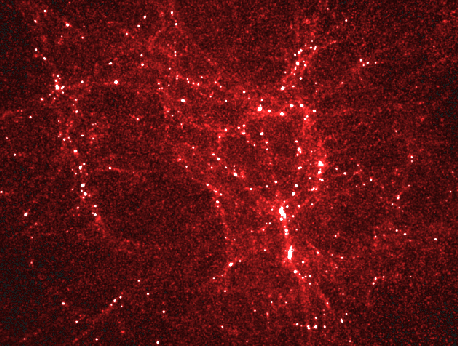
The ambition to model the universe at its inception represents the ultimate extension of this computational strategy. By tracking the gravitational interactions of millions of particles, cosmologists can simulate the transition of the universe from a near-uniform state of matter to the complex web of filaments and galaxies we observe today. These simulations do not merely recreate the past; they provide a testable hypothesis for how gravity, acting over eons, shapes the large-scale structure of existence.
This work serves as a reminder that our understanding of the world is inherently mediated by the tools we build to describe it. As our computational capacity grows, so too does the resolution of our models, allowing us to see further into the heart of the atom and back to the very first moments of the cosmos. The resulting images—whether of a nascent galaxy or a vibrating turbine—are not just data; they are the artifacts of a sustained attempt to map the unseen mechanics of the world.