Climate Models and the Resolution Challenge
As climate models grow more granular, the challenge shifts from gathering data to understanding the physical mechanisms that govern how those data interact.
The Illusion of Resolution
Modern climate modeling often resembles an attempt to map a coastline with an increasingly fine ruler. As researchers seek to bridge the gap between coarse global reanalysis products and the specific, site-level conditions that dictate local outcomes, the reliance on high-resolution gridded datasets has become standard. Yet, as recent studies demonstrate, simply increasing the density of data points does not automatically yield superior predictive power. In hydrological and meteorological applications, the performance of these models is frequently constrained by the purity of the underlying physical mechanisms rather than the complexity of the algorithms used to process them. When models attempt to correct satellite precipitation data or downscale atmospheric fields, they often encounter boundaries where terrain, moisture, and intensity interact in ways that defy simple additive logic. The introduction of machine learning and foundation model embeddings has provided a way to encode persistent surface properties—such as the way a specific patch of land departs from the coarse-grid atmospheric state—but these tools remain subordinate to the fundamental physical coherence of the input data.
The precision of a model is not merely a product of its resolution, but of the physical consistency of the variables it attempts to reconcile.
The Microclimate Frontier
The drive for granularity is nowhere more evident than in the study of forest microclimates, where the macroclimate recorded by distant weather stations often fails to capture the proximal reality experienced by understorey species. Plants do not live in the average; they live in the buffered or amplified conditions created by the canopy. By quantifying the relationship between microclimate and macroclimate, researchers have identified that different species possess distinct affinities for these localized environments. Core forest specialists, particularly bryophytes, thrive in the buffered temperatures of dense stands, while generalists favor the amplified conditions of forest edges. As disturbances reshape these landscapes, the ability to model these micro-scale processes becomes essential for predicting shifts in biodiversity, suggesting that the future of ecological modeling lies in moving away from coarse averages toward a more nuanced understanding of how local topography and vegetation structure mediate the climate.
Predicting the Anomalous
Beyond the local scale, the challenge of seasonal and mesoscale prediction remains a matter of isolating the correct physical triggers. The western North Pacific anomalous anticyclone, for instance, exhibits distinct monthly behaviors that require specific, physics-based empirical models to capture. Whether driven by Atlantic warming, the slow decay of El Niño, or sea ice melting in the Bering Strait, these phenomena demonstrate that climate prediction is rarely a matter of a single, monolithic driver. Similarly, the formation of mesoscale convective systems—the massive clusters of thunderstorms that modulate the global energy balance—relies on specific environmental conditions like total column moisture flux convergence. By identifying these natural length scales and trigger conditions, researchers are strengthening the dependence of atmospheric models on the environment, moving toward a more robust representation of the storms that define regional weather.
The Attribution Gap
The effort to attribute climate trends to anthropogenic causes has long relied on free-running models, yet these often struggle to replicate observed decadal shifts. A promising alternative has emerged in the form of counterfactual seasonal hindcasts, which allow researchers to isolate the impacts of CO2 and aerosol forcings by modifying initial conditions and forcing scenarios. These experiments reveal that while models can be tuned to capture specific radiative fluxes, they often fail to sustain the complex coupled feedbacks that characterize the tropical Pacific. The difficulty is compounded by the limitations of prescribed sea-surface temperature simulations, which often conflate physical feedbacks with statistical noise. These findings suggest that our ability to diagnose model deficiencies is currently limited by the very methods we use to test them, highlighting a need for more sophisticated approaches to dynamic attribution that account for the full, coupled nature of the Earth system.
Attribution is not a passive observation of trends, but an active interrogation of how the coupled system responds to specific, human-induced forcings.
Aerosol Earth
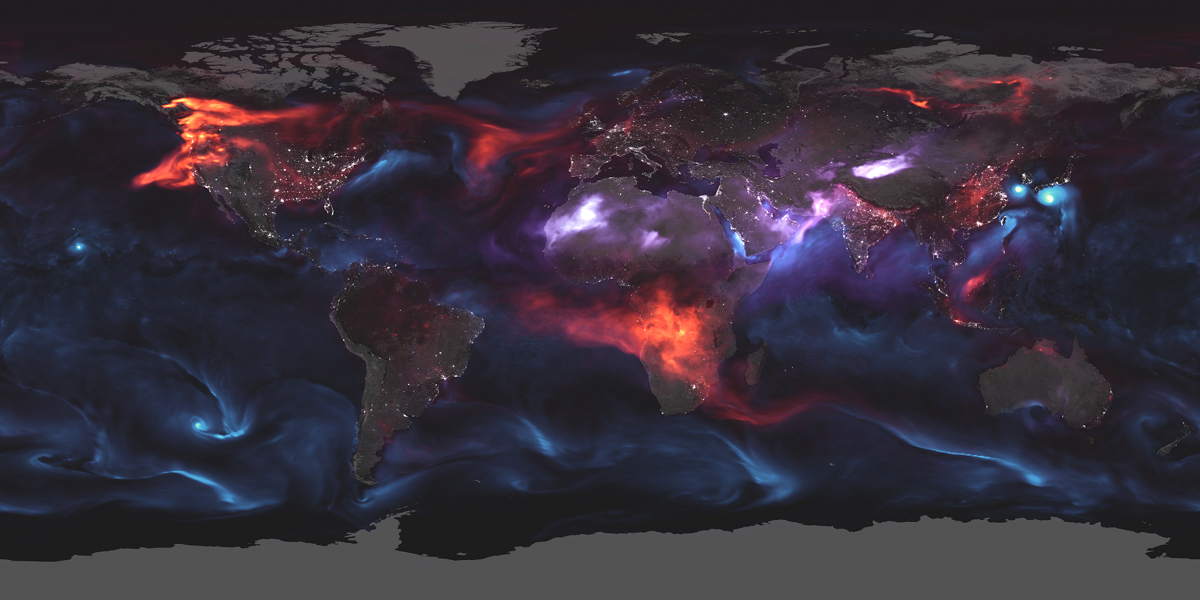
Ultimately, the visualization of the planet’s atmosphere—a swirling, real-time composite of black carbon, sea salt, and dust—serves as a reminder of the sheer complexity of the system being modeled. These aerosols, circulating in response to fires, typhoons, and desert winds, are not merely passive markers but active components of the climate. As modeling capabilities evolve, the goal remains to integrate these disparate, high-frequency observations into a coherent framework that can distinguish between the signal of human influence and the inherent, chaotic variability of the atmosphere. The progress made in recent years suggests that while we are getting better at mapping the components of this system, the task of understanding their interconnected, long-term evolution remains the central challenge of the field.