Atmospheric Control and Modern Science
From the invisible movement of particles to the deliberate steering of storm systems, modern atmospheric science is redefining our relationship with the air.
The Weight of the Invisible
The atmosphere is not a static medium but a dynamic, shifting population of particles and waves. To understand it, we must first define how we measure it. Recent advances in aerosol research have moved beyond simple binned states toward more flexible, mathematically grounded frameworks like AeroMELD. By using scale-shape decomposition, these models allow researchers to track aerosol populations without losing the structural integrity required for physical simulation. This is a departure from older, more rigid methods that often failed to capture the true diversity of mixing states in the air. Similarly, our understanding of the ocean-atmosphere interface relies on how we parameterize surface waves. By moving away from decades-old spectral models toward newer, spatially-aware techniques, we can better account for the roughness of the sea surface, which in turn dictates the momentum flux between the water and the air above it.
Atmospheric science is increasingly a study of how we represent the unseeable complexity of the air.
Tracing the Path of Pollutants
Air quality is rarely a local phenomenon. The ozone pollution observed in Central and Eastern China, for instance, is often the result of complex stratospheric intrusions. These events, where air from the lower stratosphere descends into the troposphere, can be traced back to critical source areas thousands of kilometers away. By utilizing Lagrangian simulations, researchers have identified that while direct intrusions have a more immediate, daily impact, indirect intrusions—linked to the evolution of large-scale Rossby waves—contribute significantly more to tropospheric ozone levels over the course of a month. This global connectivity is further highlighted by the tracking of open biomass burning. Using satellite data from the Fengyun-3D mission, we can now map the massive carbon emissions from fires across the globe, revealing that savanna and woody shrubland burning in the Southern Hemisphere are primary drivers of global atmospheric change.
The Hybrid Eye in the Sky
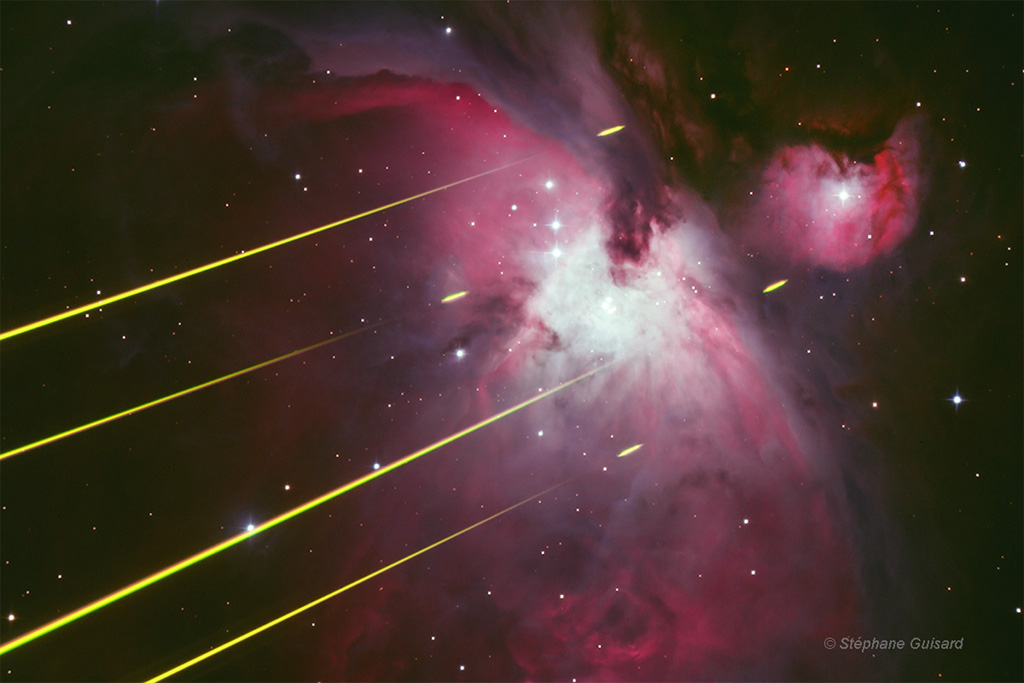
Observing the atmosphere from space requires a delicate balance between high-frequency data and computational efficiency. Traditional inversion algorithms often struggle with the simultaneous retrieval of aerosol optical thickness and fine-mode fraction, frequently relying on fixed models that cannot adapt to changing conditions. The development of hybrid algorithms, such as AIRTrans, represents a shift toward integrating radiative transfer physics with transfer learning. By training neural networks on simulated datasets and fine-tuning them with ground-based observations, these models can capture the spatiotemporal variations of aerosols with greater accuracy than official satellite products. This ability to see through the haze is not unlike the adaptive optics used by ground-based telescopes, which use lasers to excite sodium atoms in the upper atmosphere, creating artificial guide stars to correct for the blurring effects of the lower air.
Controlling the Unpredictable
The ambition to influence atmospheric outcomes is perhaps the most challenging frontier in the field. New frameworks for precipitation control, utilizing model predictive control, attempt to steer weather events by applying sparse, calculated perturbations to the atmospheric state. These methods rely on the sensitivity of numerical weather prediction models to identify where small interventions might yield significant reductions in rainfall. Such techniques are essential because the atmosphere is inherently nonlinear; open-loop control often fails where a closed-loop, predictive approach can succeed. This work is complemented by a deeper understanding of how clouds themselves act as agents of change. In the Southern Hemisphere, storm tracks are not merely products of temperature gradients; they are actively reinforced by the radiative effects of clouds, which create their own thermal feedback loops. Recognizing these feedbacks is essential for refining the models we use to project future climate states, ensuring that our simulations account for the complex, self-reinforcing nature of the world's weather systems.
We are moving from the era of simply observing the weather to the era of attempting to steer its outcomes.